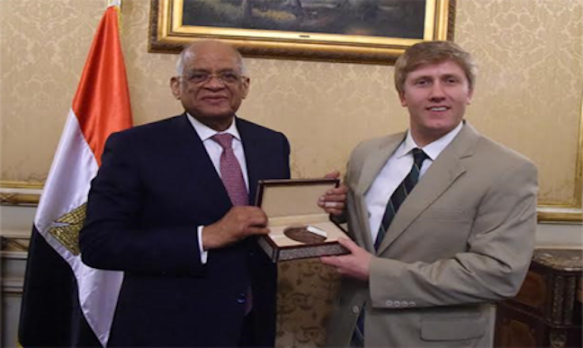
Bearing gifts: Parliament Speaker Ali Abdel-Aal trades anomalous metal object with US Vice President Pence’s chief of staff Nick Ayers during a meeting in Cairo, April 19, 2017
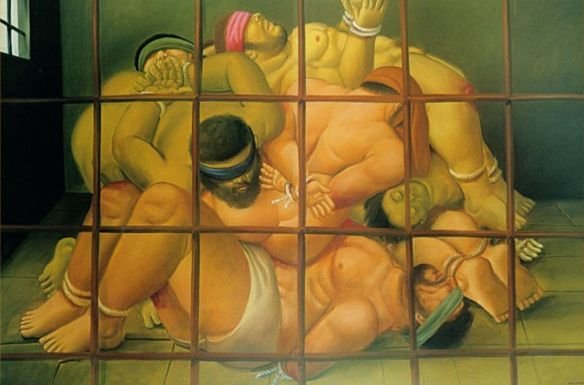
Fernando Botero (1932 -), Colombia, Abu Ghraib, from a series, 2005
Politics in so-called liberal democracies these days is mostly about hating people outside politics. Migrants are by definition non-citizens when they arrive in countries of refuge, walled and warehoused on the social margins, charily granted only limited rights to participate in the political life around them; yet fear and loathing of the symbolic figure of the refugee have helped elect a crazed American president, topple a phlegmatic German prime minister, and drive the dis-United Kingdom out of the European Union.
Although the object of hate takes protean forms (the Polish plumber, the Mexican rapist) the migrant from the Middle East is central to this dynamic. (He—it’s always he—is variously defined as “Muslim” or “Arab,” terms apparently interchangeable.) You hear two things over and over.
1) Muslims are violent. Numbers materialize to support this claim, but the figures rarely withstand examination. (See, by comparison, the recent ignominious deflation of an influential but deeply flawed report by the right-wing Quilliam Foundation, which purported to show that 84% of “grooming gang offenders” in the UK are South Asian. Dr. Ella Cockbain, a lecturer in security at University College London, calls the report “bad science” and adds that “Without clear inclusion parameters, robust and transparent methods and good data, we should be very sceptical of pseudoscientific claims and spurious statistics.”)

German honor: Duelling scars
2) This Muslim (or Arab) violence is rooted in “culture,” meaning it’s nebulous, fixed, and timeless, beyond remedy or repair. After all, Arabs (or Muslims) believe in “honor,” and the rest of us don’t. (Generations of young German men cultivated duelling scars in the name of “honor,” a male rite of passage more violent than most tribal initiations; and the motto of Hitler’s SS some seventy-five years ago was “My honor is loyalty.” These are facts best, and easily, forgotten.)
Anthropologists endlessly debate the definition of “culture.” But right-wing agitators and their pseudo-intellectual enablers know perfectly well what they mean when they throw the term around. For them “culture” is bad statistics plus speculative explanations. It’s a toxic but intoxicating brew.
In this important article (published today in German in a slightly different version in Freitag) describing an anti-migrant meeting in Berlin on November 21, Christopher Sweetapple, an anthropologist working in Berlin, unpacks some of the origins of the “cultural” discourse in anti-immigrant sentiment. It’s a discourse increasingly seductive on the German Left. I hope that after reading it you’ll listen to this podcast: a conversation on December 3 between Christopher and two anti-racist migrants’-rights activists in Berlin, “Sahra” and Olympia Bukkakis. Together they raise issues, and amplify voices, silenced and erased by the pseudo-liberal discourse around “violence” and “culture.” Bios of all three can be found at the end of this article. Thanks to Christopher, Olympia, and Sahra for sharing their words with A Paper Bird.
From Abu Ghraib to Neukölln: Neocon Repetition Compulsion in Berlin Christopher Sweetapple
I wasn’t looking forward to going to Laidak but went anyway. The purportedly leftist pub is only an 8-minute bike ride from my apartment. They were hosting a talk, “Gewalt im Namen der Ehre – Triebstruktur und Neuköllner Unzumutbarkeiten,” organized by a local initiative with the cheeky name “Ehrlos statt wehrlos” (“honorless but not helpless” in English—abbreviated here to ESW). I hadn’t yet attended any of ESW’s talks or events but did, like many in this neighborhood and city, catch the exchange of Stellungnahmen when ESW popped into existence in early August this year—first their mission statement, and then, rather swiftly, a blistering response accusing ESW of fostering a blatant right-wing populist discourse, co-signed by anti-racist, feminist, Muslim, Jewish and Roma organizations and initiatives here in Berlin.

Ten thousand stories in the naked city: ESW logo
ESW’s fundamental provocation is baked into its name, its mission statement, and the title of the talk: “Fighting violence committed in the name of honor; alliance against unacceptable conditions in Neukölln.” Neukölln is a large, populous, centrally-located Berlin district. It’s nationally known for its multicultural population. The “unacceptable conditions” that ESW imagines itself to be bravely facing are problems mainly perceived in the desirable portions of North Neukölln. The “conditions” are Muslim men, doubtless numerous and apparently primed to commit violence solely motivated by honor, or Islam, or something. This talk promised to better unpack how, culturally and psychologically speaking, this honor motivation system works.
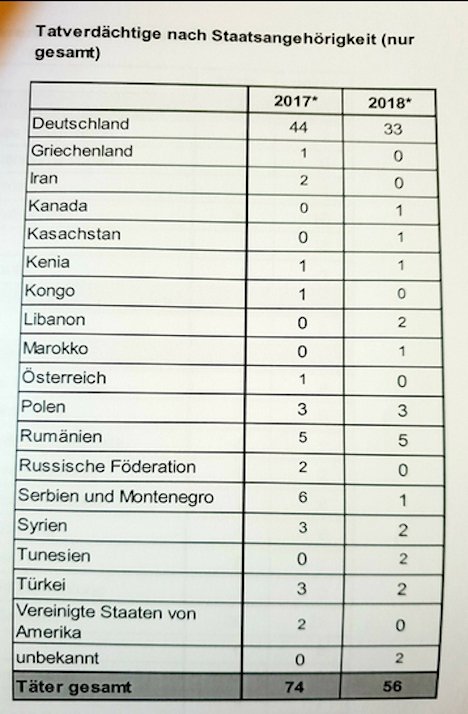
Graph published by the gay news website blu, based on data from Berlin police documenting “homophobic crime.” The table is titled “Suspects According to Nationality.” Of course, the religious identity of these suspects is unclear. Perhaps some of the Germans are Muslim; perhaps all of the Syrians are Christian. Without hard data, this is all speculation. But the data don’t indicate a crime wave, that much is certain.
Instead, factoids were marshalled haphazardly. One moment, she mentioned survey results about secondary-education-students’ attitudes as evidence for widespread antisemitism and homophobia among youth with migrant backgrounds. Not long after, she dismissed the inadequacy of official police statistics about hate crimes, offering an example (it was unclear to me whether this was hypothetical or actual) of an alleged Muslim extremist charged with a crime for making the Hitler salute at a Quds Day demonstration. His action, she said, was officially designated as “far-right” and not “Islamist,” which we were invited to see as patently ridiculous. Of course “motivation” for particular crimes may be misreported or botched by authorities. Shouldn’t this, though, spur further thought about the validity of “hate crimes” as a classification per se? And how are we supposed to assess whether or not a Muslim crime wave is underway when all we’re left with is a heap of uncollated incidents and this dismissal of official numbers as Fake News?
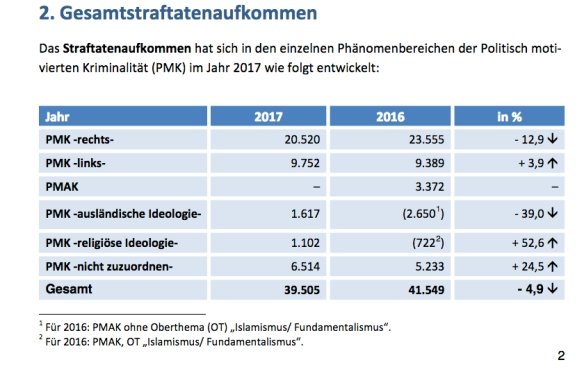
Table (“Total Volume of Politically-Motivated Crime”) from the Federal Ministry for the Interior, Building and Homeland’s report on the year 2017, published in May 2018. The “politically motivated” crime categories listed in the left column include: right, left, foreign ideology, religious ideology, and unassigned.
Just as the actual North Neukölln Muslim crime wave was asserted by fiat rather than demonstrated, so too was her confident and detailed exposition of the psychological mechanisms which motivate these Muslim perpetrators asserted without locating the source and citational history of her framework. And I can understand why. In the first case, it is always better not to show your hand when the data clearly say otherwise. And in the second, had she provided her audience with sourcing for this psychosocial account of the Muslim Mind, the jig would have been up. This psychosocial vocabulary she walked us through to explain why they do this to us is familiar to anyone sentient during the USA’s 2003 invasion of Iraq. Post-Freudian “drive theory,” a quasi-hydraulic account of an “honor/shame” mental economy, a constant slippage between ethnicity, race and religion—none of this strays far from Raphael Patai’s 1973 The Arab Mind. These ideas are embarrassing relics for contemporary social scientists and professionals, and they were central to some of the most disastrous attempts to mobilize the human sciences in recent memory. Their resurrection is shocking and repellent.

German honor: Duelling scars
Writing for the New Yorker during the Bush years, Seymour Hersh was perhaps one of the first to draw public attention to how Patai’s idiotic 1973 work had become a handbook for US military and intelligence institutions at the time. Throughout the 20th century, US anthropology, whether ensconced in universities or on contract for the RAND corporation,
churned out military-friendly readymades: “national personality” studies and Area Studies cultural psychological profiles of Patai’s sort, perhaps most notoriously in Ruth Benedict’s The Chrysanthemum and the Sword (1946). Like this ESW talk, Benedict’s book traffics in speculative metapsychology using “shame” and “honor” as primary referents to map the Japanese Mind and Japanese Culture. Other disciplines got in on the grift (Edward Banfield’s 1955 The Moral Basis of a Backwards Society, which studied the “primitive” manners of southern Italy, is a hilarious iteration in political science’s specialized language); but eventually even mainstream anthropology turned one, then several, corners, leaving much of this entire approach in the dust. Not coincidentally, the year in which Patai’s book was published, 1973, was also the publication date of Talal Asad’s edited volume Anthropology and the Colonial Encounter—a dissection of the profession’s deep implication in imperial power which is actually studied and read today without a tongue lodged in cheek.
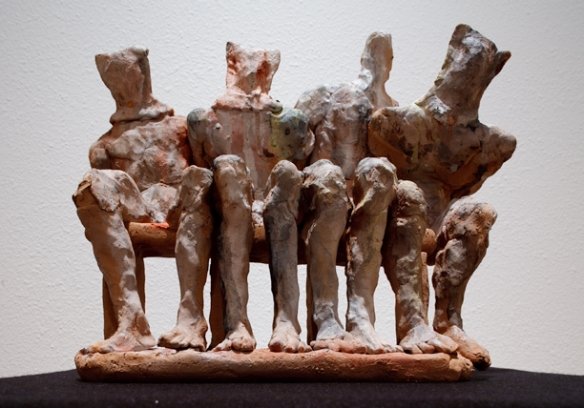
Abdel-Karim Khalil (1960 -), Iraq, Detainees, 2004
The Arab Mind’s authoritative, racist fable of the so-called “Arab” psyche armed the personnel of Abu Ghraib prison with actionable fantasy-knowledge about vulnerabilities in “Arab” masculinity, partially motivating several of the forms of sexual humiliation and torture inmates endured. Even more than other anthropological excursions into imperial apologetics, Patai’s ideas are fictions fitted for military use. They found a further theater in which to enact themselves in the still-running show at the USA’s other famous prison colony, Guantanamo. The American Psychological Association and other umbrella organizations of professional psychologists continue to grapple with how their profession was enlisted in enhanced interrogations and torture. For its part, the main professional organization of anthropologists, the American Anthropological Association, recoiled at the rollout of the US Army’s Human Terrain System, which sought to give social scientists the role of battlefield advisors on matters of local culture and custom in Afghanistan.

And this little piggy: a 2017 poster (“Islam?” Doesn’t suit our cooking. Trust yourself, Germany!) for the extremist Alternative für Deutschland party. The racist politicians eventually pulled the ad, fearing it incited not antipathy toward Muslims but sympathy for the pig.
Even if the ESW speaker didn’t deign to mention Patai or the ignoble tradition to which her discourse belongs, neocon canards do plainly rhyme. They’re a chord easily heard. They gather together comfortably in symbolic space, and they apparently still pack a room. They impose a clash-of-civilizations geopolitics and a billiard-ball model of cultures. They compel a battlefield stance and combat posture whenever the Islam alarm is tripped. They buttress a bundle of irrational certainties about the Islam-designated-out-group, certainties which do not withstand scientific scrutiny. Their recent history and track record is repellent because neocon concepts reek of guarded racial animus and evangelical zeal, not notably noble motivations. Bootstrapped to interpretations of a perceived crime wave, neocon concepts algorithmically suggest a character roster of acceptable victims who, not so subtly, mirror the imputed switchpoints of the lone villain’s psyche—a villain we might call Muhammad
Doe. Neocon concepts provide a narrative arc for the salvation of the victims and the vanquishing of the villain. First, we must know our enemy, his culture and his psychology, his habits and hang-ups. Then—the rest is (recent) history.
In Black Skin, White Masks (1952), Franz Fanon directed the reader’s focus to the psychosocial double-binds facing both the colonized and “the other, the white man, who had woven me from a thousand details, anecdotes, stories.” “Woven” is a fitting word to convey the fabrications at the heart of racist oppressions: fabrications that incite an insincere empiricism hell-bent on collecting “a thousand details, anecdotes, stories,” all in the service of extravagant mythologizing about the violent Other meant to excuse violence against the Other. Lamentably, this is no less true in Neukölln than in Abu Ghraib. ESW’s name inverts an old Social Democratic slogan from the 1930s; a party official proclaimed that Hitler had stripped the SPD of strength but not honor. Negating an anti-Nazi rallying cry is perhaps not an auspicious move. The call not to be “defenseless” against migrants carries an undertone of threat. A YouTube account—self-branded with an “anti–deutsch” symbol and a byline that reads “Donald Trump, OI, OI, OI!”—posted a recording of parts of the November 21 talk, with an ominous #bashback hashtag. Before these concerned citizens start drawing up their plans to bash the Muslim Mind out of Neukölln, they might take heed of this old Hegelian chestnut: “Evil resides in the gaze which perceives evil all around it.”
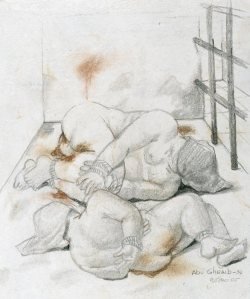
Fernando Botero (1932 -), Colombia, Abu Ghraib, from a series, 2005
The revival of these tropes in ESW’s discourse—or, why not? hate speech—here in Neukölln breathes fresh life into ongoing anti-Muslim racism: that is evident. The task remains to keep the benefit of the doubt alive: to hope that the interest in these ideas on display this November at Laidak is still partially open to facts, still persuadable. But I have no illusions that the task ahead—to disabuse a sizeable swath of the activist left in Berlin of their seemingly cherished neocon clichés—is easy. That remains a large and unappealing undertaking.
It continues to baffle any person actually aware of the conservative and right-wing discourse of the USA to encounter the same language and arguments recycled by young academics who declare themselves antifascists. But this garbage anthropology is not simply baffling or laughable; it’s also dangerous. By smuggling pernicious neocon ideas into progressive spaces, whether leftist cafes or queer-feminist organizations, and arming its hosts with pseudo-knowledge about Islam and the Muslim Mind, the minimal gains made against encroaching anti-Muslim racism are brazenly rolled back. This is a threatening situation for everyone, not least for the Muslims and those-perceived-to-be-Muslim who actually live here.
Again, please listen to further discussion of these issues on the podcast, with:
Olympia Bukkakis, a performer and artist who has lived in Neukölln, Berlin since 2012. She has been deeply involved in the burgeoning drag scene there and organizes the successful show Queens Against Borders. Olympia is a white, trans-femme Australian and a radical leftist as yet unaffiliated with any political parties or organizations.
Sahra (name changed), an activist and educator who also lives in Neukölln, Berlin. After growing up in elsewhere Germany and completing her studies abroad, she came to Berlin and spent many years working inside queer-feminist and anti-racist initiatives and organizations. “Sahra” is a queer German Muslima of color and radical leftist and is unaffiliated with any political party.
Christopher Sweetapple, an anthropologist who lives in Neukölln. He is in the midst of completing his dissertation about his fieldwork among queer anti-racist activists in Berlin; he is the editor of the recently published The Queer Intersectional in Contemporary Germany (available as a free pdf from Psychosozial-Verlag). Christopher is a white US citizen, cis gay man, and radical leftist.
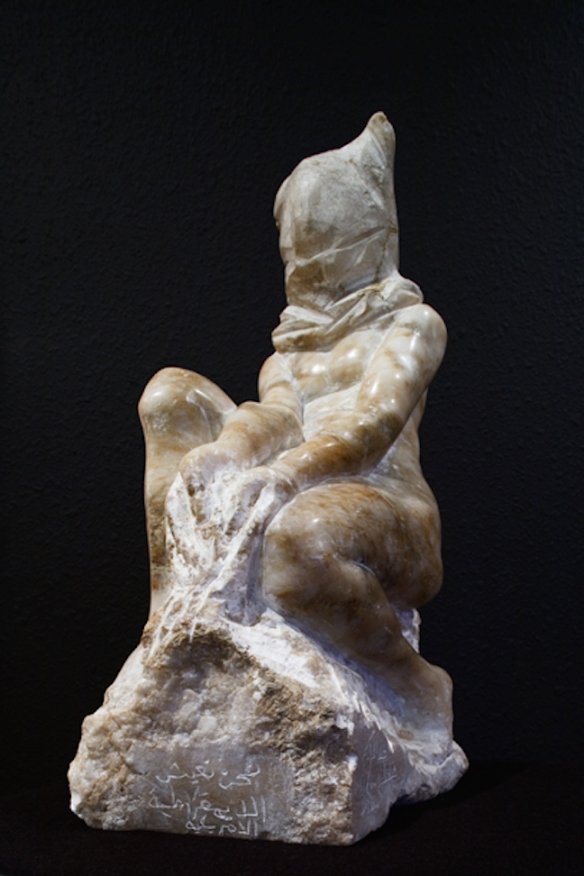
Abdel-Karim Khalil (1960 -), Iraq, We are Living in an American Democracy, 2004
Egypt’s Wipe-Out-the-Queers Bill
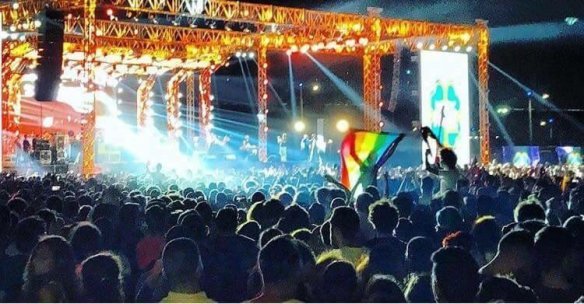
Forbidden colors: A rainbow flag is waved at Mashrou’ Leila’s concert in Cairo, September 22, 2017
Egypt’s crackdown on transgender and gay people started almost exactly four years ago, just a few months after General Abdel Fattah el-Sisi seized power. I wrote here about its first stirrings — a police raid in mid-October 2013 on an allegedly “pervert”-owned gym in a working-class corner of Cairo, followed by another raid on a party in a somewhat tonier suburb. The arrests have widened ever since, too many and too brutal for me to chronicle. Moral panic has become a mainstay of the dictatorship’s legitimacy. Now the country’s Parliament seems likely to debate a bill aimed at punishing, jailing, extirpating anything even remotely connected to homosexuality. It’s reminiscent of Uganda’s notorious Anti-Homosexuality Act (remember that?), which kept the international human rights community mobilized in opposition for years. In some ways, perhaps, it’s more dangerous; for here’s a government utterly contemptuous of foreign or domestic opinion, armed with enormous surveillance capacity (much of it courtesy of the United States) and limitless police power, already experienced at repression, ready to repress more.
The draft bill was submitted last week by MP Riad Abdel Sattar, along with at least twelve other sponsors. Here is the text, as published in Masrawy, an Egyptian web portal.
Article One:
In this Act, homosexuals [mithliyeen] shall refer to any sexual relationship between the same sex, either two or more males or two or more females.
Article Two:
Any two or more persons, either male or female, who engage in perverted sexual relations between themselves in any public or private place shall be punishable by imprisonment for a period of not less than one year and not more than three years. In the case of a repeat offense, the penalty shall be imprisonment for five years.
Article Three:
Any person who incites homosexual relations by any means, whether by instigating, facilitating, or preparing a place to practice them or encouraging others to engage in them, even if he is not practicing them, shall be punishable by imprisonment for a period of not less than one year and not more than three years. In the case of a repeat offense, the penalty shall be imprisonment for five years.
Article Four:
It is strictly prohibited to advertise or publicize any homosexual gathering by any means of advertising, whether audible or visible, or through social media. In such a case, the advertiser and promoter shall be punishable by imprisonment for a period of three years. If such an event takes place, the organizer or organizers and whoever participated through any form of participation shall be punished. If natural persons [that is, individuals as opposed to organizations], they shall be punishable by imprisonment for a period of three years. If a legal person [e.g., a business or NGO] is responsible, their legal representative shall be punishable with imprisonment, and both the entity and venue will be closed.
Article Five:
It is prohibited to carry any symbol or code for homosexuals, or to manufacture, sell, market, or advertise it. Anyone who violates this shall be punishable by imprisonment for a period of not less than one year and not more than three years.
Article Six:
The penalties contained in the preceding articles shall be followed by a period of probation equal to the duration of the sentence. [Probation, or “monitoring,” in Egypt is inflicted on convicted persons after their release from the penitentiary. Usually, throughout the period of probation, the person must spend every night at the nearest police station, from dusk to dawn. This provision effectively doubles the prison sentences.]
Article Seven:
The penalties in the preceding articles will be accompanied by their publication in two widely-published daily newspapers.
Just read it again, right down to the obligation of an unfree press to participate in public shaming. It’s total, totalitarian, comprehensive.
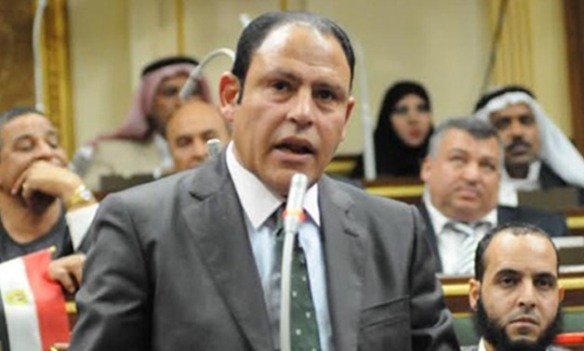
Moral MP: Riad Abdel Sattar
Riad Abdel Sattar is an idiot whose most notable recent legislative initiative was a proposal to force all Facebook users to register with the state and pay a monthly fee. This, he said, would help Egypt “fight terrorism” by “revealing who uses the site correctly and who uses it wrongly against state institutions.” The Wipe-Out-the-Queers bill is born of similar paranoia. He is, however, an idiot with some influence. He belongs to the Free Egyptians party, the largest single faction in Parliament. Created after the Revolution by the telecommunications billionaire Naguib Sawiris, the party proudly sells itself as secular, liberal, pro-market, committed to democracy. It therefore supported Sisi’s military coup. (Early this year, Sawiris found himself expelled from the party he’d founded and funded, essentially for showing insufficient pro-Sisi enthusiasm. He suggested jealously that the President had taken over the Free Egyptians the way the state might nationalize a business.)
Sisi is a semi-fascist if not a fullblown one, but he has a peculiar relationship to politics. The Nuremberg rallies, the mass and the mob, are not his style. Unlike the country’s previous dictators, he has not formed a party of his own to mobilize (and reward) supporters. He prefers to let Parliament look divided and vaguely pluralist, while pitting factions against each other and encouraging splits in any group that (like the Free Egyptians) sustains a following. This reveals the essential nature of his regime. Sisi’s government distrusts its own people deeply, disdains any elected official who must address the despised and unruly people, puts exclusive faith in its military and security cadres, and rules through brute force. Instead of cultivating a party of devoted politicians to help keep him popular, Sisi lets the politicians compete, grovel, and cower in the dirt to court him. Riad Abdel Sattar is good at this. He knows he needs Sisi’s favor in order to enjoy the petty privileges of parliamentarians (he appears to spend a great deal of time finding well-paid jobs for his many relatives). So he’s mastered the regime’s distinctive language, its copulation of moralism with militarism. Introducing his bill, he “stressed the need for the family, school and religious institutions … to spread the true religious awareness and alert society to the seriousness of homosexuality.” He also said that “moral deviance” is “no less dangerous than violence and terrorism. It is even more dangerous to society.” This is Sisi’s liberal, secular Egypt, hailed by American neoconservatives, showing its freedom and beauty.

Loner: Sisi in full drag at the opening of his new Suez Canal, 2015
It’s sometimes said that, at present, “Homosexuality is not explicitly criminalised under Egyptian law.” This is a misunderstanding. Very few laws around the world explicitly mention “homosexuality.” Most laws on same-sex sexuality are antique and arcane ones, using terms like “sodomy,” or “buggery,” or “acts against the order of nature.” Yet that doesn’t mean they fall short of criminalizing homosexual acts. Egyptian law currently penalizes fugur or “debauchery,” a similarly vague word: the punishment is from three months to three years in prison. A 1975 ruling by the country’s highest court expressly defined fugur as non-commercial, consensual sex between two men. That ruling is repeatedly cited by prosecutors and courts today, in condemning trans and gay suspects to prison. (In the current crackdown, judges have tacked on multiple convictions under related provisions to give cumulative prison sentences as high as twelve years.) In that sense, fugur is not much different from “sodomy” — a term that has meant many things over the centuries, including sex between humans and animals and between Christians and non-Christians, but has always included sex between men, and has been used to punish it.
As If: On Alaa Abd el Fattah
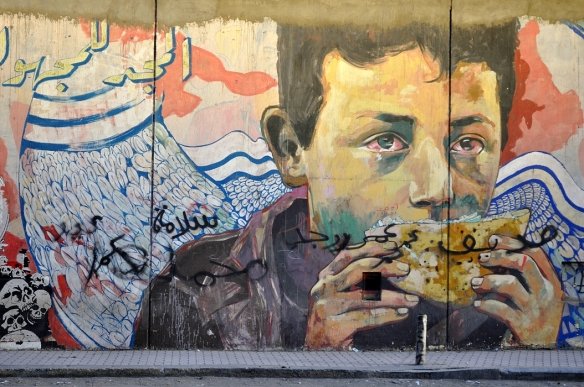
Bread, freedom, dignity: Street art in downtown Cairo, 2015, photo by ChrisJ for TrekEarth
In a quarter-century of visiting prisons or sitting in courtrooms and prosecutors’ offices, I’ve never really learned why states single out some people as special targets of retribution. Harmless groups (ranging from gays, emos, heavy-metal fans, to the peaceful Baha’i or the Rohingya) or lone individuals become symbols of everything the government loathes and wants to extirpate, the Jungian beasts that haunt its midnight dreams. Despite their innocence or weakness, they find themselves hemmed by all the instruments of power, the police with their guns, the torture machines, the prison walls. Sometimes there’s popular panic behind the repression, but sometimes the state seems random in picking out its demons. There’s a logic, but the logic of nightmare: a reminder that politics is, as Max Weber wrote, the realm not only of means and ends but of irrational beings, and that to engage in it is to traffic with “the diabolical powers that lurk in all force.”
I do speculate, though. I’ve come over the years to think that what power fears most of all is one phrase: “as if.”
In English (the next few lines are meant to appease linguists and other nerds) “as if” introduces the subjunctive mood, a verb form that describes unreal events. These can be fantasies of the present (“she looks as if she were Laila Elwi“), the future (“she looks as if she were going to the Prince’s ball”), or even the past (“she looks as if she were dead since Thursday”). “As if” announces a state of affairs that is not; it’s a portal though which fear and desire overtly enter the apparently hushed and sober halls of language. And once “as if” has been said — once the desire is voiced, the fear made legible — you can act on the longing or transcend the fear. It pushes beyond the passport controls at fantasy’s borders; its premise can move people’s bodies and minds, make them speak or stand as if that unreal world actually were theirs.
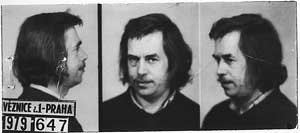
Vaclav Havel, arrested for protesting in defense of the Charter 77 principles in Czechoslovakia, 1970s
I first saw this in Eastern Europe. To be a “dissident” in the old-time Soviet bloc could mean many things, but it encompassed a shared style of action. To be a dissident was to act as if one were living in a free country. It was to write things, to speak, to hold a placard, to demonstrate, as if it were permitted rather than punishable by law. And this meant
forcing the state to reveal itself: to show what it really was. Governments that put fraudulent charters of rights in their pseudo-socialist constitutions, that signed treaties, that pretended to be “people’s democracies,” could not bear people who acted as if democracy were real. That was the core of dissent, of the small cadres of people whose small, individual acts in time overthrew a massive, inhuman system. They changed the actual world by acting on the subjunctive. (“Really-existing socialism,” which never really existed, had a considerable tolerance for fantasy, as long as it remained fantasy. I was reminded recently that, in the Soviet Union in the desolate and stagnant Brezhnev years, when dictatorship lost even the pretense of purpose or charisma and lay on the people like a smothering, infected blanket, there was a large renaissance of science fiction. It was tolerated on the principle that the less real the other worlds where people took consolation, the more surreal and unachievable, the safer. Dream as you like. But do not act on it.)
I recognized this subjunctive faith again in the early years when I visited Cairo, between 2001 and 2003. Egypt had dissidents who put themselves on the line just as the legendary figures of eastern European dissent had. Their organizational loyalties were complex and sometimes conflicting (they tended to cluster round the Popular Committee to Support the Palestinian People’s Intifada, and later Kefaya — the two groups that arguably spearheaded anti-Mubarak actions on the democratic Left) but they had one strategy: to act as if the promises in the politicians’ rhetoric, and the Egyptian Constitution, were real; as if theirs were a free society, and not a dictatorship in thrift-shop democratic drag. Thus you demonstrated even though a thousand cops in riot gear kettled you in; you wrote what you wanted, even if State Security paid you a midnight call; you raised your voices, even if truncheons came down on your head. If you were jailed or tortured, that meant the regime had been forced to cast off its disguise, to reveal its real nature. And if you succeeded — if the demonstration went ahead, the article were published, the poster stayed on the wall — you had pushed the envelope slightly, you’d made the regime back off, you’d expanded by a millimetre or two the available space for freedom. Either outcome was a victory, whatever the personal cost.
The Egyptian regime was terrified, and arguably in the end was overthrown, by a few people acting on a hypothetical; by the weight of bodies and a grammatical construction. It’s in this light that I think of the life of Alaa Abd El Fattah.
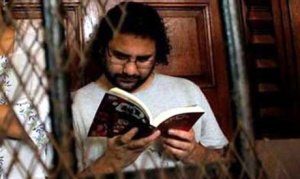
Alaa Abdel-Fattah on trial in 2013 (Photo: Al-Ahram)
Alaa will turn 36 in a month, almost certainly still in prison. That’s half a lifetime, and for somewhat more than half of that he’s been an activist and dissident. Four successive Egyptian regimes — Mubarak’s, the military junta that succeeded him, the Muslim Brotherhood in its brief interval of power, and the military dictatorship of General Sisi — have treated him both as their favorite scapegoat and their most
feared enemy. There has been, in past years, almost no excuse they won’t use to arrest him; there’s been no charge they won’t fling at him, and no act of popular anger for which they won’t assign him blame. During Egypt’s only free presidential election in 2012, the headquarters of the military-backed (and ultimately losing) candidate caught fire. The army’s lackeys could find no likelier arsonist to libel than Alaa. (“Witnesses said they saw Alaa and his sister asleep in a car near the office minutes before,” they solemnly declared.) There was no evidence; there was nothing at all; yet a bogus “investigation” continued till another military regime, almost two years later, could hand a one-year suspended sentence to Alaa and his sister. Alaa exists less as a person than as a djinn or poltergeist or figure in a fairy tale, travelling on a magic laptop to wreak havoc on State Security’s plans, the omnipotent goblin in the fever dreams of delirious generals. “Thinking of installing a GPS tracker and live update my location publicly. Maybe this would stop the false accusations,” Alaa wrote during this particular fiasco.
I mention this because, despite the court ordeal, this was one of many points where the state’s obsession with Alaa achieved an almost comic incongruity with reality. (I once watched the actual, non-omnipotent, arson-incompetent Alaa spend five minutes trying, and failing, to light a match.) But of course it’s not a comedy in the end. Nothing in Egypt is. Alaa would furiously reject the idea that he is unique, or more important than the other thousands — 60,000, by human rights activists’ count — enduring Egypt’s immense gulag. But he is uniquely important to innumerable Egyptians. Street artists stealthily stenciled his rounded, bearded face on walls around the country during his many jail terms. The images fade (graffiti is another subversive act for which the Sisi regime has imposed hefty penalties) but his presence, even in prison, refuses to evanesce. He remains a symbol of Egypt’s Revolution, and not just of that: of the long and seemingly hopeless struggle that led up to it, as well as the slow, losing battle to hold onto its gains. “He’s history,” we say in English, to dismiss someone as over, done. Alaa is the history that still contains futurity, pulsing under its surface like a thrumming engine, visible as a vein. The regimes’ fear is that history is the future: that this buried embodied energy, the blood and the anger, will not go away.
It took some time, and long back-and-forths with his marvellous sister Mona Seif, for me to straighten out even the bare outline of how many times he’s been arrested. I’m not sure anyone, even State Security, keeps an exact count. Twelve years ago, as a blogger — at a time when the Internet opened new public spheres for uncensored information — he started writing about human rights, and reporting on demonstrations. In 2005, the day of a referendum to allow contested Presidential elections for the first time ever, pro-regime thugs assaulted anti-Mubarak protesters with fists and clubs. They attacked Alaa’s mother in the crowd, and beat him when he intervened to defend her. The next year, he spent 45 days in jail for demonstrating for greater judicial independence. His prestige came partly from the combination of what he wrote and what he did. His words led to his actions; the as if became real.
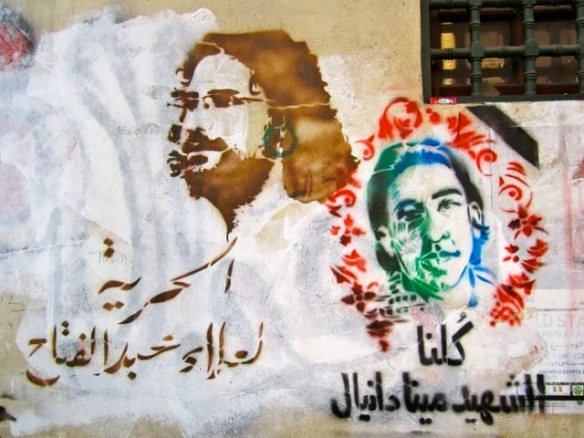
Stencil of Alaa Abd El Fattah with the martyr Mina Daniel (R), killed during the millitary assault on demonstrators at the Maspero Building, October 9-10, 2011: photo, Mashallah News
Abroad when the 2011 revolution broke out, he returned and stood in Tahrir Square during the uprising’s last days. After a short recessional, state violence returned, and by the summer of 2011, the military were extending their control over both government and public life. In October, soldiers killed 27 mostly Christian marchers near the state broadcasting building in Maspero. Alaa had supported their demands for equality; a military court charged him with “inciting” the peaceful protesters, who in turn incited their murderers to kill them. He refused to recognize the army’s legal jurisdiction over civilians; in that stalemate, his son, Khaled, was born while he languished in jail. He was freed, and eventually cleared, but soon after, the alleged arson case had risen in its place. His life increasingly seemed a series of accusations springing up like undead vampires from jack-in-the-box graves, a legal horror parade of interrogations and cells.
After Sisi’s 2013 military coup, the environment grew darker. In November 2013, he was slapped with new charges for allegedly organizing a demonstration in front of Egypt’s rubber-stamp parliament, to protest constitutional changes.that would have installed military trials like a permanent tumor in the justice system. Security forces seized and questioned the so-called “Shura Council” demonstrators one by one: two dozen of them, all asked about their relations with the dreaded Alaa. Alaa himself waited outside the prosecutor’s office for hours, inviting interrogation. But State Security preferred to burst into his flat on November 28, a 20-man assault team with masks and flak jackets and machine guns. They abducted him and they beat his wife, Manal. “‘I’d like to see the warrant,’” she said: “It was as if the word ‘warrant’ was the filthiest name you could call their mothers.” She remembered:
And suddenly it was as if I was outside the scene and it turned into a surrealist spectacle from which I remember shots like in a comic strip: close-up on an unshaved face and yellow teeth while he’s hitting me and insulting me. Or the boss in the suit hitting me and calling me names … Anyone who’s worried about me: please don’t be. I didn’t feel violated or broken. No. I was strong. You know, my worst nightmare is being abused and trying to scream but my voice does’t come out – and that didn’t happen. Actually, for a moment, I pitied them: the Ministry and the officers and their thugs and Sisi and SCAF. I felt they were so tiny – I’m not sure how to describe this, but I kind of thought “wow – Alaa’s really driving you this mad?”
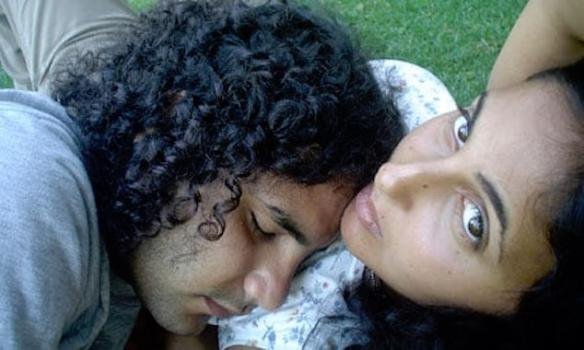
Alaa Abd El Fattah and his wife Manal in 2011; photo by Nasser Nasser/AP
Alaa and his twenty-four co-defendants were jailed for three months, released, then re-arrested. He went on hunger strike late that summer, when his father lay in critical condition in the hospital. The last time I saw him was at the wake after his father died, in August 2014. He’d been released briefly, under guard, for the funeral; he stood swaying in the receiving line outside the venerable Omar Makram mosque in central Cairo, as thousands of Egypt’s weeping revolutionaries filed past, mourning not just the aged, brave dissident but the faded promise of democracy. Alaa wore his prison whites, which always suggest pilgrimage to me. He looked dazed by the light, by the fragility of freedom. We exchanged brief words. In February 2015, Alaa received five years in prison for illegally demonstrating. (Under Egyptian law, it will be followed by five years’ “probation,” meaning sleeping every night in a police cell from dusk to dawn.)
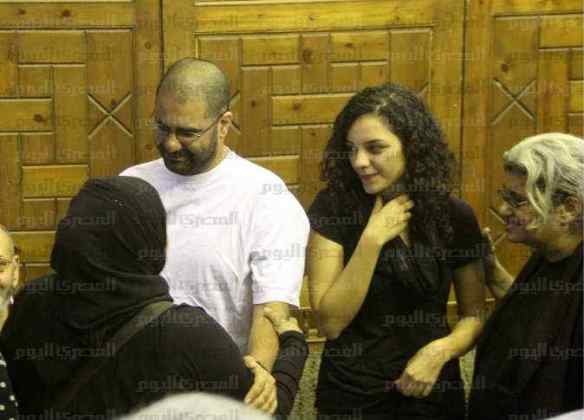
Alaa Abd El Fattah, his younger sister Sanaa Seif, and his mother Laila Soueif (L -R) at Ahmed Seif el-Islam’s wake at Omar Makram Mosque, August 30, 2014. Photo by Hazem Abdul Hamid for Al Masry Al Youm
Alaa’s ailing father, a distinguished rights defender who was also his defense attorney, had said at a press conference in 2014: “I wanted you to inherit a democratic society that guards your rights, my son. But instead I passed on the prison cell that held me, and now holds you.” The cell still confines Alaa. All other defendants but one in the Shura Council case have received presidential pardons. His own case lingers. Moreover, on September 30 this year, he faced a hearing in yet another trial, with two dozen more defendants: this time, for “insulting the judiciary.” (In a 2013 tweet criticizing a paranoid case mounted against civil society workers, Alaa suggested the judges were “taking orders from the military.”) This time the court postponed the hearing till December. A conviction could add a year or more to his sentence, in a maximum security prison. An appeal before Egypt’s Cassation Court against his five-year Shura Council sentence was also postponed on October 19; a judge recused himself without giving reasons, and adjourned the case till November. Egyptian justice is a mill that grinds hope to sand and ashes.
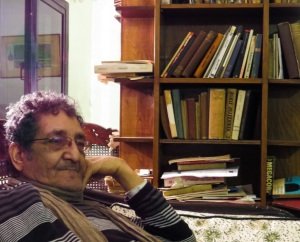
Ahmed Seif al-Islam in the offices of the Hisham Mubarak Law Centre, Cairo, Egypt
I’ve said little about his extraordinary family. His father, Ahmed Seif al-Islam, was himself jailed for five years and tortured under Hosni Mubarak’s regime. One of Egypt’s first and best human rights lawyers, he defended arrested Islamists and accused gay men with equal passion. Alaa’s mother, Laila Soueif, has protested dictatorships for thirty years. His two younger sisters are activists as well. After the 2011 revolution, Mona Seif launched an unprecedented
campaign to end military trials for civilians. Sanaa Seif spent a year in prison starting in 2014 — for demonstrating against draconian laws barring the right to demonstrate. His aunt, Ahdaf Soueif, and his cousin, Omar Robert Hamilton, are activists and writers in two languages, but always drawn back to the capillaries of Cairo where the pulse of action drums. It would be no wonder if such ancestral burdens intimidated him; certainly the wealth they’ve written about him leaves outsiders with precious little more to say. Through Mona, I asked their mother why she thinks he has been such a bête noire to government after government. “I always find it difficult to answer questions that reflect on the motivation of those in power,” she wrote, “but I will try.”
Authorities in Egypt are and have always been very suspicious of any attempt by groups of young people to organize themselves autonomously. In the years leading up to the revolution, with the spread of the use of the internet and later social media it became virtually impossible to try and control the growing trend of young people connecting with each other outside the influence of the authorities. This caused a kind of panic in different state organs … Alaa was and remains a very central figure in this trend, personally I believe this is the core cause behind the hatred with which authoritarian politicians regard Alaa and why they are so vindictive towards him.
The motives of power are always opaque. But its panics are lucid, exact in their illogic. It’s connection the generals and bureaucrats fear: the promiscuous, unregulated interactions of the young. Here, too, Alaa was a central symbol. You see him, pudgy and dishevelled, and he looks a bit like a rotund potato; but like a tuber, he transcends himself when the state’s dirt and darkness silt and bury everything. It takes a mother to recognize the terrible tendrils a son’s self can extend underground; it takes love to envision the connections he can contain.
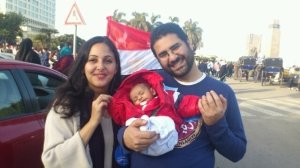
Manal Hassan, Alaa, and their son Khaled in 2012: photo by Paola Caridi at https://www.invisiblearabs.com
You have to read him to understand what this means. My friend Jillian York, herself an expert in digital security and the needs of fragile social movement in the region, said to me a few weeks ago: “Alaa gave me my political education.” And she wrote:
Despite the fact the he is only (and exactly) six months my senior, the
friend has also been one of my most important teachers, reminding me to take risks and not being afraid to tell me when I’m not going far enough, not doing enough. ….I’ve said it to reporters so many times that it’s almost lost its meaning, but I’ll say it again: Alaa is in prison not because he committed a crime, not because he said too much, but because his very existence poses a threat to the state.
The revolutionary editor Lina Attalah captured some of Alaa’s talk, between trials, back
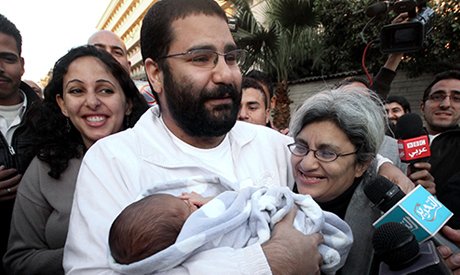
Alaa Abd El Fattah hugs his newly born son Khaled and his mother, Laila Soueif, after his release from prison in December 2011
“The marginalized are always the core,” he said. From Christians, to tuk tuk drivers, to gay people, Alaa glorified how they challenge the status quo by denying its existence. “Now if you count the marginalized in all their forms, we are the majority, because it includes women, the poor, those who live in slums, in rural areas … That makes the mainstream a minority.” …
He sees the alliance in post-Mubarak Tahrir, where the mainstream men and women – both Christians and Muslims – of the “gentrified square” retreated, ceding the place to street sellers, gangs and what-not. Along with the remaining activists of the square, this alliance stayed on, claiming post-uprising demands at a time when many others went back home seeking “stability.” Those who slammed Alaa and his fellow activists for continuing the revolution after February were jealous, he says, because the fluidity of its identity allowed for cross-class solidarity. This keeps the revolution alive.
When Alaa recalls criticism from counter-revolutionaries, the key words are “long hair, defends thugs and gangs, gay.” He is jubilant to know that the markers of marginalization have come to define the defamation campaign against him. If this does anything, it proves him right.
Not long after, he wrote similarly in one of many letters smuggled out of prison cells:
This time, I’m alone, in a cell with eight men who shouldn’t be here; poor, helpless, unjustly held – the guilty among them and the innocent.
As soon as they learned I was one of the “young people of the revolution” they started to curse out the revolution and how it had failed to clean up the ministry of the interior. I spend my first two days listening to stories of torture at the hands of a police force that insists on not being reformed; that takes out its defeat on the bodies of the poor and the helpless. …
In the few hours that sunlight enters the dark cell we read what a past cellmate has inscribed on the walls in an elegant Arabic calligraphy. Four walls covered from floor to ceiling in Qur’anic verses and prayers and invocations and reflections. And what reads like a powerful desire to repent.
Next day we discover, in a low corner, the date of execution of our cellmate of the past. Our tears conquer us. The guilty make plans for repentance. What can the innocent do?
My thoughts wander as I listen to the radio. … [Fellow prisoner] Abu Malek interrupts my thoughts: “I swear by God if this revolution doesn’t do something radical about injustice it will sink without a trace.”
He wrote that in the first year after the Eighteen Days that overthrew Mubarak, when the possibility of popular movements taking a radical, anti-capitalist, and anti-militaristic turn was still very much alive. This was an as if the state particularly feared: as if the hardened deadweight of class power and military repression could be shaken off the people’s backs. To imagine it required an especially intense vision of connections, what they might be and, more importantly, how they could be forged. This was work into which Alaa plunged: all the strains in his own family – a feminist faith in the personal, an ecumenical fervor for human rights, a strategic belief in nonviolence, a dream of democracy – came together in him, at one juncture in time, in concentrated form.
When I talked in 2011-2012 to some veterans of Midan Tahrir, they often clung hard to a radically utopian and politically very unreal version of what had happened there: that it was a perfect moment when all divisions of class, gender, race, and power simply melted away and everyone was “just Egyptian,” or “Egyptian together.” The remaining role of politics was to get back to this garden, as if Marx or Gramsci had given way to a Joni Mitchell song. This vision of the warm, dissolving, comforting adhesiveness of Rousseau’s volonté générale was a fiction and a dangerous one, because it implied there was no more work to do, just waiting for the unity to re-arrive. Alaa knew better; unity was a hope not a given, it had to be won, and the powerful had to lose power in the process. As they failed to do so, the unhealed rifts of politics and history set back in. In early 2016, from prison, he looked back, and acknowledged a counterrevolution so destructive that preserving anyone’s “innocence” against others’ “guilt” was impossible. What remained was a different struggle, a different return: to the apparently hopeless hypotheticals of ten years before.
In 2013, we started to lose the battle for narrative to a poisonous polarization between a rabidly militarized pseudo-secular statism and a viciously sectarian-paranoid form of Islamism. All I remember about 2013 is how shrill I sounded screaming “A plague on both your houses,” how whiny and melodramatic it felt to complain about the curse of Cassandra warning of an all-consuming fire when no one would listen. As the streets were taken over by rallies that raised the photos of policemen instead of their victims, sit-ins were filled with chants against the Shia, and Coptic conspiracies flourished, my words lost any power and yet they continued to pour out of me. I still had a voice, even if only a handful would listen.
But then the state decided to end the conflict by committing the first crime against humanity in the history of the republic. The barriers of fear and despair would return after the Rabea al-Adaweya massacre. Another battle of narrative would start: getting non-Islamists to accept that a massacre had happened at all, to reject the violence committed in their name.
Three months after the massacre I was back in prison, and my prose took on a strange new role: to call on revolutionaries to admit defeat. To give up the optimism that had become dangerous in its encouragement to choose sides: a military triumphalism or an unpopular and impractical insistence on complete regime change.
I narrated defeat because the very language of revolution was lost to us, replaced by a dangerous cocktail of nationalist, nativist, collectivist and post-colonialist language, appropriated by both sides of the conflict and used to spin convoluted conspiracy theories and spread paranoia. … What we needed was all the strength we could muster to maintain some basic defence of human rights.
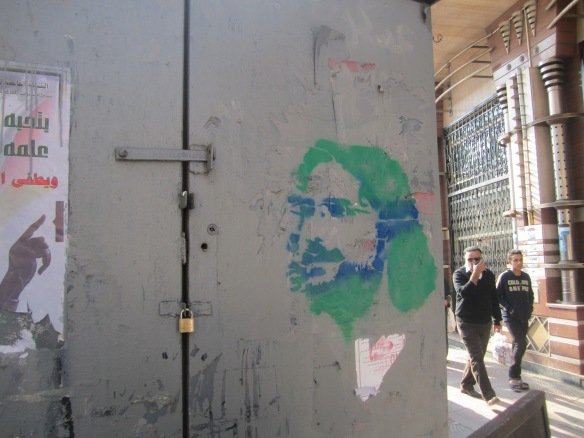
Graffiti of Alaa Abd El Fattah on a Cairo street while he was jailed in 2011; photo from https://lonelygirltravels.com/category/subculture/street-art-art-culture-and-rock-n-roll/
In prison now, security forces randomly deny Alaa access to books — for him, the food of hope. His sister wrote me, “Alaa often refers to his emotional status as el talaga, ‘the fridge,’ and when he describes it he says he tries to maintain a strict hold on all his emotions, expectations tightly locked so that he doesn’t get too emotionally invested in anything or excited about anything and then get brutally disappointed.” The dwindling letters he writes have a dedicated readership in National Security; they only sporadically reach their intended recipients. “At one point it became too emotionally consuming for him to share personal reflections that will end up forgotten in some officer’s desk drawers.” He keeps writing, though, in any way he can. The best I can do here is to keep quoting — from, for instance, a short essay he managed to get through the walls in April:
Personally, I’ve come out of a decade of anger with a few simple lessons. I’ve realized that every step on the path of struggle or debate within society is an opportunity for understanding, connecting, dreaming and planning. Even when things seem simple or decided, even when we’re clear about which side of an argument we’re on, or about the need to abandon a particular argument altogether, seizing opportunities to pursue and produce meaning remains a necessity; without it we will never get beyond defeat. …
Finally, siding with power is generally unproductive. The powerful need nothing from you but to parrot their propaganda. The powerless, on the other hand, often cause as much trouble as they suffer. Their arguments and discourses are often as brittle as their positions in society and their diminishing chances of safety and survival. Taking their side, therefore, even as an experiment, is a catalyst for deeper reflection, deeper investigation, deeper analysis and imagination.
Once we were present, then we were defeated, and meaning was defeated with us. But we have not perished yet, and meaning too lives on. Perhaps our defeat was inevitable, but the chaos that is sweeping the world will sooner or later give birth to a new world, a world that will — of course — be run by the victors. But nothing will constrain the strong, nor shape the margins of freedom and justice, nor define spaces of beauty and possibilities for a common life except the weak, who insist that meaning should prevail — even after defeat.
And he has a message, finally, for those not in Egypt, for whom the politics of Cairo have become so alienating and confusing, who can’t conceive of what to do, who lapse back into old Orientalist fantasies about an ungovernable country that deserves what it gets. This confusion hardens to indifference; it paralyzes. (In the last few weeks, I tried to get a piece about Alaa published in the international press, and found it terribly difficult. LGBT Egyptians, who were suffering their own horrors during those weeks, were the topic of the month. Repression claims so many victims in Egypt that Sisi can easily distract critics just by vomiting up a different kind, like Apple announcing a new IPhone.) Yet the synoptic view linking the local to the global is what Alaa stresses again and again. “I have learned that ruling regimes are mere obstacles. The real challenges are international in nature,” he wrote, “which is why debate is so important.” He urged, in a statement to international internet activists around the same time:
Fix your own democracy: This has always been my answer to the question “how can we help?” I still believe it is the only possible answer. Not only is where you live, work, vote, pay tax and organize the place where you have more influence, but a setback for human rights in a place where democracy has deep roots is certain to be used as an excuse for even worse violations in societies where rights are more fragile. I trust recent events made it evident that there is much that needs fixing. I look forward to being inspired by how you go about fixing it.
Don’t play the game of nations: We lose much when you allow your work to be used as an instrument of foreign policy no matter how benign your current ruling coalition is. We risk much when human rights advocacy becomes a weapon in a cold war (just as the Arab revolutions were lost when revolutionaries found themselves unwitting and unwilling recruits in proxy wars between regional powers). We reach out to you not in search of powerful allies but because we confront the same global problems, and share universal values, and with a firm belief in the power of solidarity.
Defend complexity and diversity: No change to the structure of or organization of the internet can make my life safer. My online speech is often used against me in the courts and in smear campaigns, but it isn’t the reason why I am prosecuted; my offline activity is. My late father served a similar term for his activism before there was a web. What the internet has truly changed is not political dissent but rather social dissent. We must protect it as a safe space where people can experiment with gender and sexual identities, explore what it means to be gay or a single mom or an atheist or a christian in the Middle East, but also what it means to be black and angry in the U.S., to be Muslim and ostracized in Europe, or to be a coal miner in a world that must cut back on greenhouse gases. The internet is the only space where all different modes of being Palestinian can meet. If I express this precariousness in symbolic violence, will you hear me out? Will you protect me from both prosecution by the establishment and exploitation by the well-funded fringe extremists?
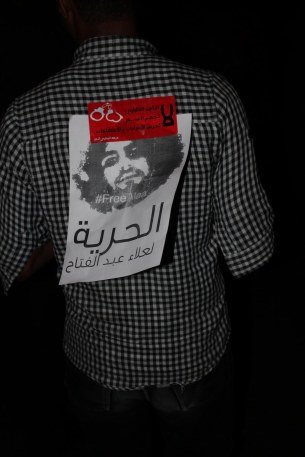
Protester at an October 2011 Cairo march against military abuses carries a poster on his back: “Free Alaa Abdel Fattah. No military tribunals, no more emergency law, down with military rule.” Photo from http://she2i2.blogspot.com/2011/10/
I derive several things from that, for my international colleagues. Power — the friendly power of your own governments that say they have the world’s best interests in mind — won’t save you. It won’t change things, not for the better. Power must be battled, not befriended, wherever you face it. So, yes, you can fight at home, against the international system that contrives to extinguish hope, that keeps Alaa Abd El Fattah and 60,000 others in Egypt jailed. The system is huge. Egypt is only one small part, and the US and Europe prop up its indistiguishable dictators because of still larger goals against which 100 million Egyptians shrivel to paltriness: the priorities of Israeli occupation, or Saudi oil. Yet things can change. On the one hand, global arms sales to Egypt actually increased fourfold in the two
years after Sisi’s coup and the attendant massacres. On the other: a few activists in Berlin, protesting last week against German complicity in the Egyptian crackdown on LGBT people, forced their government to cancel a planned security training for Egyptian police, meant to teach how to monitor web “extremism” (and repress any political activity they fear). The machinery of state terror, that produces terror and uses it to justify more, can be rolled back, even in small ways. That’s an immense victory.
Somewhile back, a Moroccan friend who studied linguistics wrote me, magisterially: “In Arabic as contrasted to English, the subjunctive mode is much more closely coordinated with desire.” I have no idea whether this is true (or, indeed, exactly what it means). But “coordinated with desire” is a marvellous phrase, and seems indeed to describe something recognizable about Oum Kulthoum songs or Mahfouz’s novels, permeated not just with an “as if” but with a tangible, urgent “I want” beating in every pause for breath. That transformation of impossibility into desire is the essential predicate of revolution.
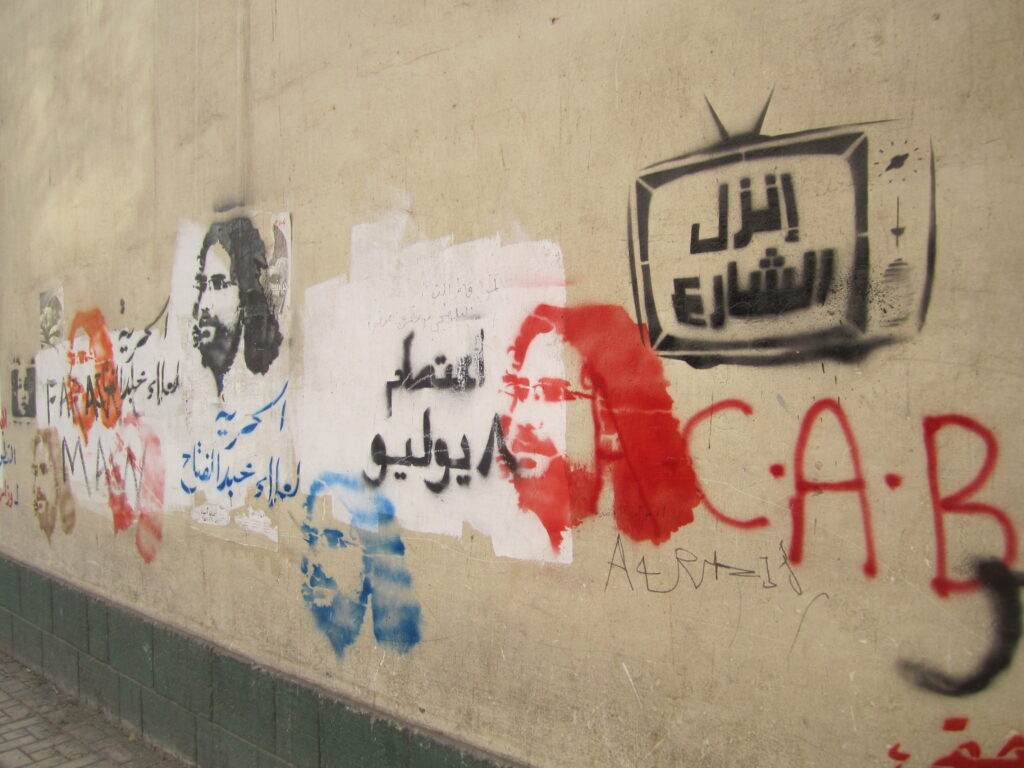
More Cairo graffiti of Alaa Abd El Fattah from 2011; the script to the left calls for a sit-in, while the words inside the TV screen read, “Go down to the streets.” Photo from https://lonelygirltravels.files.wordpress.com/2011/11/img_2494.jpg
I’ll just close with a story, one I often tell. I came back to Egypt for a few days in late 2005, for its first-ever contested Presidential election in history (Alaa had demonstrated six months earlier for the constitutional change that permitted the contest). The election itself was a sham staged for the Bush administration’s benefit. Mubarak jailed his main opponent, Ayman Nour, both before and after the brief campaign, and gave himself 89% of the votes. (Nour was later forced to leave Egypt after Sisi’s coup, and now lives in exile.) However, on voting day, September 7, a few dozen of the usual suspects — young activists from Kefaya, mostly — gathered at noon on the green roundabout in Midan Tahrir for what they expected to be the usual tiny, police-ringed protest. I came too and we walked in circles, chanting, till suddenly it hit everyone at once: the police weren’t there. The ranks of black- clad, armored Central Security conscripts who invariably came to kettle in and confine even the tiniest protest were miraculously, inexplicably, absent. Conscious that diplomats and the international press corps were all over Cairo that day, Mubarak had decided to stage a little simulacrum of democratic rights.
The next flash came quickly: We could do what we wanted. Limbs stretched like sleepers waking. Almost instantly the little demonstration moved off the greensward and started marching, up Talaat Harb street into downtown Cairo. It grew as we walked, to maybe a thousand or more. People sang, they danced. The sense of physical liberation, freedom from the huge constricting weight of the state’s riot gear and weapons, was incredible. It was if a hundred bodies had been unstrung from straitjackets at once. Along the street, shoppers and shopkeepers stared as if we’d gone insane; a few, envying the joy of the uncalendared moulid, peeled off to join us. The ecstatic procession wound through central Cairo, turning near Ramsis Station to approach the old presidential palace at Abdin; and there, where the streets widened and the shoulder-to-shoulder solidarity softened (and after the foreign reporters, losing interest, had decamped to grab a beer) Mubarak’s paid thugs emerged from the alleyways, to club and batter those along the edges. The march broke up in fear and confusion, as friends raced to protect one another. Yet the memory is so vivid for me, I can almost taste the sweat and the exhaust fumes in the air. I don’t know that I’ve ever seen people so purely happy. I missed the Eighteen Days in Midan Tahrir, but that one day gave me a feeling for what it must have been like. It was the hour of as if, when lives mummified in fear and custom break free. I don’t recall any faces from the procession, strangely, just bodies dancing, arms raised high; I’m not sure if Alaa or his family were there, or were at some other demonstration in Cairo, or were arguing elsewhere with the police. I abase myself for my own forgetting. The failure of memory to hold steadfastly enough to the past corrupts history; its weakness puts the future itself in danger. Yet when I think of Alaa I remember enough of that afternoon to know: a day like that is what I want for him, as if he were free.
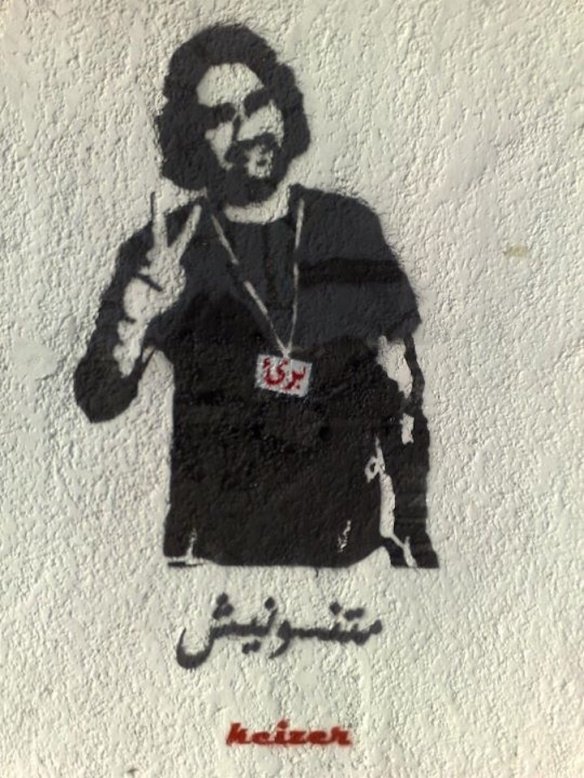
Street art depicting Alaa Abd El Fattah by Keizer, Cairo, 2016-2017. The placard around his neck reads “Innocent”; the words below: “Don’t forget me.”
Egypt: Interrogating the terrorist Scott Long
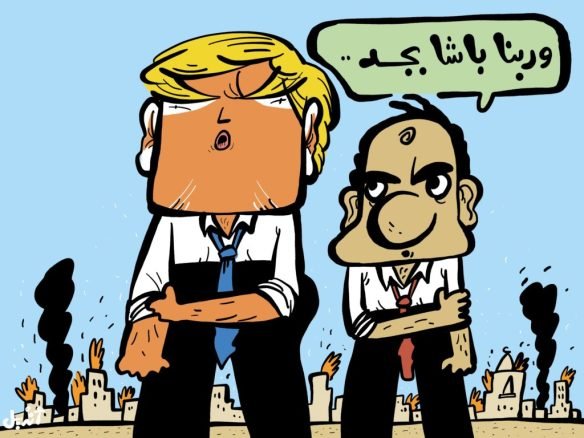
“Source of Inspiration”: cartoon by Andeel, Mada Masr, November 2016. Sisi says: “A true pasha, by God.”
I hadn’t meant to write about this. It’s small compared to what many Egyptians face, or fear. But a few Egyptian friends have urged me to record it, partly because accounts of recent State Security interrogations are somewhat rare (people used to say that to meet the secret police was to go “behind the sun,” to disappear); partly because it illuminates what is on whatever passes for the dictatorial regime’s mind. Recent events, too, make me believe there’s a need, in the United States and elsewhere, to remember some things. I’ll get to that. Let me begin at the beginning.
The beginning is an ending. I left Egypt in March. Most likely, I will never be permitted to return. I had lived there for three and a half years, and for the last three of those I did not cross the borders at all. After the military coup in July 2013, it became increasingly clear to me that when I left, I would be denied re-entry; and that meant I delayed my departure until – when? I told myself: until I had finished everything I came for, or until there was nothing more to do.
For a long time – since 2005 – I’d been stopped at Cairo passport control every time I came into the country; taken aside, held for an hour or two, detained once in a locked room in the airport that had the forlorn graffiti of Palestinian refugees scrawled across the walls: then finally admitted. No questions asked, no explanation given. It was obvious I had been on some sort of list for years, that the state did not quite know what to do with me when I applied for entry. (US citizens do not need to buy visas in advance to enter Egypt; as a result, each of my arrivals took officialdom by surprise.) That was all back in the comparatively louche eras of Mubarak and Morsi. After the coup and Sisi’s seizure of power, the fact of being on a list seemed much more serious. In Cairo, I went underground — though it hardly felt so dramatic. I avoided contact with officialdom; I did not renew my entry visa. When necessary I blustered my way through ubiquitous checkpoints, never showing my passport. I bribed my building’s doorman not to register my presence with the police. And, toward the end, I moved to parts of Cairo where foreigners rarely went; I was far from inconspicuous there – some days, probably the only blond person within a kilometer or two — but in terms of what the police might expect I was off the edge of the world, off the books. For the last eight months I lived in Faisal, a vast warrenlike semi-slum stretching westward, and ultimately I settled in an “informal area” there: Cairo’s equivalent of a favela, streets not paved or named or usually shown on maps. The buildings, six or seven stories tall, were erected by the residents who migrated there, brick by brick and floor by floor; the first and generally last sign that you were in an informal area was that you never had to pay an electric bill, since all the power was siphoned from the official grid. I felt oddly safe there, as if I were curled in one of Kafka’s burrows, a dead end.
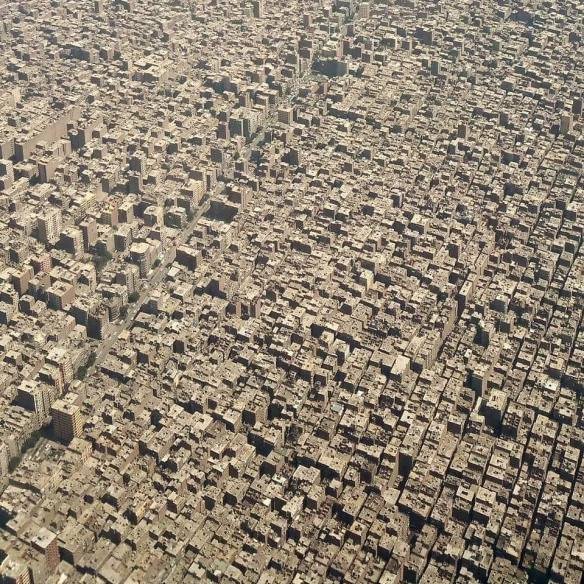
The Embaba quarter of Cairo, looking very much like the Faisal neighborhood where I lived
It’s difficult to describe my last six months in Egypt. Depression settled over everything in the country; no change seemed possible any longer, and you felt your imagination being buried in cement. Many people I cared about simply stopped leaving their homes. At last, I was invited to a conference in the US in March – organized by friends who, I think, had constructed a giant hook to haul me out of there. I knew if I went, it would be my final departure.

Leaving Egypt, the hard way
I talked to human rights lawyers after my ticket was booked. Overstaying a visa is a crime usually incurring only a minor fine at the airport, the equivalent of $30-40 US (at the time). The work and the writing I’d been doing put me in a different position, though. The lawyers told me I would be interrogated; the passenger manifest would ensure State Security was alert to my departure. I should get there early, keep their numbers on my phone, be prepared for possible arrest.
I spent my last night ever in Egypt crying
encrypting my hard drive, and uploading sensitive files to the cloud. A dear Egyptian friend drove me to the airport in the clean air of dawn, almost six hours before my flight. At passport control, they sent me down a hallway to pay the visa fine. I shelled out money to a civilian in a little office (one lesson: in Egypt, the government makes sure you settle your outstanding debts before they arrest you). “Wait a moment.” A man in a leather overcoat came in and told me to follow.
There is vertical power and horizontal power. I suppose in the US we are used to power revealed in perpendicular terms: skyscrapers, helicopters, bombers, drones. In Egypt, as in many other countries where I’ve worked, power is horizontal, shown not through height but through ambit, remoteness, segregation. I was led down an even longer corridor, so long that it seemed I was going to another terminal, or to some other place outside Cairo altogether, a hell not subterranean but suburban. Generalissimo Sisi plans to build Egypt a new capital city, far from protesters and ordinary people, distant in the desert; I imagine it linked to Cairo by a single interminable hallway.
Then: a small office, two wooden desks, two men: one in mustache and leather jacket, seated; one standing – an assistant, in short-sleeved shirt and tie. On Mustache’s desk was a stack of paper: perhaps 300 printed-out pages from this blog. A smaller stack was a printout of my Facebook page; another seemed to be news articles that had quoted me. A computer on the second desk was unplugged; hence, I guess, the hard copy. I sat down, asked their names, was told those were not “relevant.” No further explanation. The questions started.
Mustache did the asking, in English, while Necktie, now sitting at the other desk, took Arabic notes. There was no Good Cop/Bad Cop, only Talking Cop/Writing Cop, the two tasks apparently too complex for a single cop to master. We started oddly. Atop the pile of blog posts was one I wrote in 2013, comparing Sisi the dictator to the late Empress Elizabeth of Austria-Hungary – known as “Sissi,” and commemorated in many blearily romantic Romy Schneider movies. It was labored and unfunny, but it had annoyed somebody. Mustache: “What are you saying here about our President? Are you saying that our President is a woman?”

This is not the President of Egypt
I really don’t remember what I answered, except that President Sisi’s rampant masculinity would surely only be underscored by a judicious comparison with Romy Schneider. It was fitting that the interrogation began with gender, since I’d stressed the he-male obsessions of the Egyptian state in much of what I wrote. Beneath that post in the pile, though, was one on life in death-racked Cairo in the days after the August 2013 Rabaa massacre; and then the politics peered through. Mustache: You write that you were walking around the city in that period. Were you not aware there was a curfew? Who allowed you to violate the curfew? Did you violate the curfew in order to meet with criminals?
First notable fact: They knew my online life thoroughly, at least its non-password-protected part: any writer would want such a devoted audience. One or two questions suggested they might possibly have intercepted e-mail (though I’d tried to use Tor) or phone calls. But they seemed to have no idea where I’d been living physically for the last year. They asked me repeatedly, and I gave fictional addresses (I truly hope they were fictional, that no actual 233 Mohamed Moussa Street in Faisal gave its inhabitants a disagreeable surprise). Necktie noted down the invented domiciles with stoic docility. The attraction of online surveillance for indolent secret police is that it’s a desk job.
Second: They never asked me explicitly about homosexuality, mine or anybody else’s. Mustache leafed through my posts on the subject (You feel a great freedom to criticize the culture and the values of the Egyptian people. Who gives you that freedom?) but avoided touching the topic directly as if it were contagious. (What Egyptian laws have you violated? he did demand repeatedly. Please name the Egyptian laws you have violated while in Egypt.) The closest he came was asking me, while gingerly fingering blog pages, whether I had a “website” on Grindr — pronounced to rhyme with “slender.” (Truly, I did not.) Mustache also inquired, upon Necktie’s prompting, Have you downloaded pornographic information over the Internet? One thing chilled me when I recollected it in tranquillity: Mustache asked, Have you ever assisted a person with mental health problems? Have you provided psychological advice to troubled persons? I said no, and only afterward did I remember that, the previous summer, I got repeated emails from an anonymous gay Egyptian who said he was depressed and wanted help finding a psychologist. I offered him contacts; but he kept insisting on seeing me face-to-face, proposing meeting places too close to my local police station for my comfort. (Police at that station, in Doqqi, were entrapping victims almost weekly over the Internet. Lazy as always, the cops steer their prey to meet at points in walking distance of the jail.) He made me very uneasy, and I finally stopped answering him. I felt ashamed of succumbing to suspicion. And who knows?
Third: What they did care about was politics, and a particular kind of politics. The real question – never exactly framed, but implicit in most everything – was whether I would say something to tag myself as a terrorist.
Sex interested them mainly as a division of, or gateway to, larger fields of violent subversion. Particularly telling was when they got round to a legal advice manual for Egyptian LGBT people, in Arabic, which I had agreed to host on my blog. For whom was this written? Mustache demanded, holding up the pages. I stared back blankly. The post said, in clear Arabic, that it was meant for LGBT people. “It was written by Egyptians for other Egyptians,” I said. Mustache replied, as Necktie’s pen scrawled softly: So it was written to benefit people who are planning violent acts against the state?
Our back-and-forth lasted four hours. Almost every question came up again and again – to trip me up, obviously. It was like being shipwrecked in a whirlpool, and watching flotsam from other wrecks whirl by, and circle, and then swirl by again, and realizing this can only end when you drown. A week later, I jotted down some of the questions I remembered. I didn’t record my answers, so if you’re looking for hints on how to fence verbally with secret police officers, you won’t get them here. But the basic rule, as always with repressive power, is to say “no” to everything. Perhaps, in the age of iron to come, that monotonous “no” is the only mark of selfhood that will survive us.
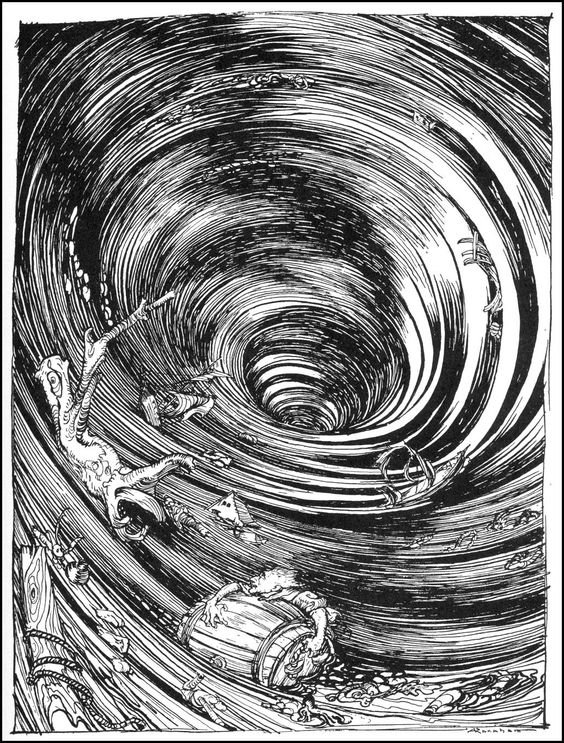
Illustration by Arthur Rackham for Edgar Allan Poe’s “A Descent Into the Maelstrom”
- Why did you overstay your visa? (I pulled out all the medical documents from my two stints in hospital in Egypt; I had been too sick, I said, to violate any Egyptian laws or download porn, much less board an airplane or get my visa renewed.)
- How have you spent your time while living illegally in Egypt? (Writing.) Writing what? (What you have in your hand.) Who pays for your writing? Do you write libellous statements about the leaders of other countries, or just about Egypt? (I do recall my answer: “I’ve written about many countries. The only person who ever accused me of libel was a very vain Englishman.” They didn’t ask who.)
- Mustache paused at two other blog posts near the top of the stack. Have you ever been imprisoned in Jamaica? Have you ever been imprisoned in Tunisia? For what crime were you arrested in Tunisia? (I have never been in Tunisia.) Who do you cooperate with in Tunisia? Why do you insult the Tunisian state? Who were you arrested with in Tunisia?
- Inevitably: Have you visited Israel? Then: Have you visited Iran? Why do you write about Iran? Who do you cooperate with in Iran? Have you visited Syria? Have you visited Libya? Have you visited Qatar? Who do you know in Qatar? Who do you cooperate with in Qatar? When did you visit Qatar? Who visits you from Qatar? What money have you received from Qatar? (I’ve never been near Qatar, though I’ve been quoted often by Al Jazeera — I believe Mustache had printed out samples. But the Doha regime, which supported the Muslim Brotherhood, is Sisi’s special bête noire.)
- Human Rights Watch and Amnesty International are effectively banned in Egypt. My onetime tenure at HRW weighed on their minds. What is your current function with Human Rights Watch? What information do you transmit to Human Rights Watch? And: How do you receive your salary from Human Rights Watch? (Courier pigeon.)
- Where did you receive information on how to hide things on the Internet? (Mustache was fascinated by posts I’d done on Internet security, several of them in Arabic.) Do private companies make these things, or foreign governments? Are you paid by these private companies? You are in contact with which criminal groups who use these en-cryp-ti-on (carefully pronounced) methods? Also on technology: Which firearms do you own? (Gun ownership is legally restricted in Egypt. I have never even held a gun.) We know Americans love firearms, where have you purchased firearms in Egypt? Who in Egypt gave you firearms? Where do you keep your firearms?
- They asked me about my “connections” with three individuals. First was Hossam Bahgat, the activist and journalist who is now banned from travel in an investigation into “illegal” NGOs. (I said, accurately, that we were were busy people who hadn’t spoken much in years.) Next was Alaa Abd El Fattah, the revolutionary activist. (I said, accurately, he’d been imprisoned on false charges for most of the time I was in Egypt.) The third was an Italian who’d been entrapped over the Internet and deported in 2015. (I said, accurately, we barely knew each other.) Mustache seemed about to produce more names when a phone call interrupted him, and after that the interrogation moved to other things.
- But they did care about organizations. Which unregistered organizations do you belong to? Have you used your home for meetings of illegal organizations? Which illegal organizations have you given money? Do you have an Egyptian bank account? Which Egyptians use your foreign bank account? When did you last receive money from abroad? Have you received money for Egyptians? For what Egyptians have you received foreign money? What Egyptians have you given money? No, no, none, no, none, never, no, none, none; then half an hour later, Are you a member of ….
- But the most sinister questions were about places. Have you ever lived in Heliopolis? Have you ever worked in Heliopolis? — a district in eastern Cairo. Then: Have you ever visited Sinai? I said truthfully I never had, but Sinai kept coming up over and over at intervals, like a brightly painted barrel in the maelstrom. When was the last time you visited Sinai? Where did you go in Sinai? Have you ever been to Sharm el-Sheikh? To Dahab? When were you in El Arish? Who has travelled to Sinai with you? Who did you meet in Sinai? Later Heliopolis bobbed up again. Who are your connections in Heliopolis? Do you belong to organizations in Heliopolis? How often did you visit Heliopolis during the summer of 2015? And: Which days were you in Heliopolis in June 2015?
North Sinai harbors the largest, ISIS-affiliated insurgency against Sisi’s rule. Heliopolis, though, is mainly for shoppers. I rarely went there, and not till later did I speculate on why they cared. Possibly they wanted to connect me to some illicit gay ring in the suburb. Memorably, though, a bomb blew apart Hisham Barakat — Egypt’s prosecutor general — in Heliopolis on June 29, 2015. The insistent dates made me wonder if they were looking to build some insane link to his murder. (I had said extremely harsh things about Barakat in e-mails to non-Egyptians after his killing — if death can be deserved, he deserved it.) The final fact, though, was: for them, perverted sex cases and security fears were becoming the same.
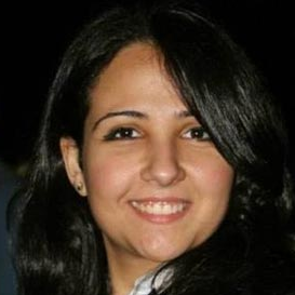
Aya Hegazy
Possibly all this was meant just to scare the hell out of me; if so the ludicrousness interfered with the lesson. But the narrative weaving through the interrogation was no more ludicrous than most of the terror trials Sisi’s security state has put together. It’s a state that holds more than 40,000 political prisoners. Famously, in 2013 three Al Jazeera journalists were arrested, then sentenced to years in prison on “terrorism” charges. for reporting on Muslim Brotherhood protests in Cairo. Their camera tripods and studio lights were held up on TV as terrorist equipment.
From Mustache’s manner and intensity, I’m fairly sure State Security was ready to concoct some such case against me, if I’d answered enough questions wrong. Being a foreigner is no longer a mark of safety in Egypt: the Al Jazeera case sucked an Egyptian, a Canadian, and an Australian citizen into the desert gulag, clearly meant as a message that passports are no protection. A US citizen, Aya Hegazy, has been held in pre-trial detention, along with seven Egyptian colleagues, for two and a half years. She had founded a Cairo NGO housing and rehabilitating street children; she’s facing highly dubious charges of sexual abuse — and of luring susceptible kids to enlist in the Muslim Brotherhood as “terrorists.” It’s widely seen as another brutal warning to civil society (and a way of punishing homeless youth, who I can testify were among the bravest and fiercest demonstrators against police repression, under Morsi as well as Sisi, from 2011 on). I don’t mean for a second that imprisoning foreigners is somehow worse than imprisoning Egyptians. But it marks a regime that no longer feels any restraint, whose fears and fantasies drive it to ever more sweeping and unstoppable measures of control. The US has done almost nothing to protest Aya Hegazy’s persecution. (Hillary Clinton asked for her release during a September meeting with Sisi, according to Clinton’s campaign.) On January 25, about six weeks before I left the country, security forces in Cairo kidnapped a young Italian student named Giulio Regeni. He disappeared from a street near where I often stayed at night. His savagely mutilated corpse turned up in a ditch a week later. That did arouse international anger — because of the horrible mercilessness of his torture, because his family demanded justice. Possibly the blowback from Regeni’s slaughter contributed to a decision not to arrest me. State Security may have felt it wasn’t worthwhile to risk extra chiding from abroad. I bear the spectral guilt of having profited from another person’s death.
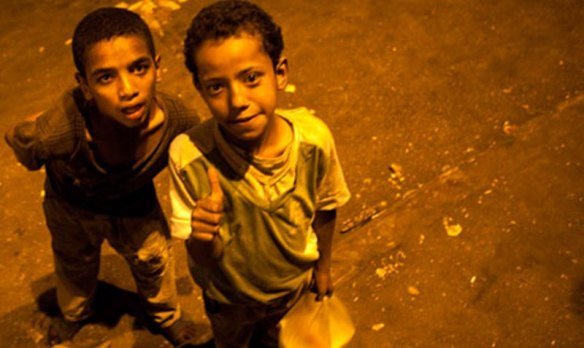
Street children in Midan Tahrir, Cairo, early 2013. Photo by Reuters
The interrogation in the airport office droned on and on. About 45 minutes before my plane was due to leave, I said, more or less: “If you make me miss my flight, I assume you are arresting me. In that case, I want to call a lawyer now.” (The idea of “calling a lawyer” is lunacy in that context; at best you send a text from a cellphone hidden in your sock.) Mustache and Necktie whispered for five minutes. Mustache left the room. I was sweating.
Ten minutes later he came back. “Go,” he said. They physically shoved me out the door.
Since I left — escaped? — Egypt, I’ve often been asked why I stayed so long. It is difficult to explain. One way to say it is: something not just disorienting but morally vitating inhabits the way “international” human rights work is done; the rhythm of parachuting in, polevaulting out of “troubled places,” absconding with information from one country, processing it into useable fact in another, perpetually at multiple removes from the people whose stories you record or the actual workers who help you record them. In this realm, too, power is remoteness, distance. I stayed in Egypt after the arrests began because I wanted not to distance myself. I wanted to stay and work with my friends. At least we would share some of the burdens together.
If I had a clear function in our informal division of labor, it was to get the word out to the foreign world about what was happening in Egypt’s crackdown, to mobilize movements to answer. I failed. Undoubtedly there were many reasons I failed, personal inadequacies to start. One reason, though, was the way Sisi’s regime has taken up “security” as its identity and purpose. Despite the self-destructiveness and ineptitude of nearly all his anti-terror measures, Sisi has sold himself to the West — as well as to Saudi Arabia and Russia — as a bulwark against the numinous, universal threat. As a result, no ally will criticize him seriously and no leader will spurn his embrace. Newspapers and even human rights groups prefer to focus on abuses elsewhere, more congruent with the unwritten battle-plans of the endless war on terror. This isn’t just for foreign consumption. In Egypt, the language of security is all-pervading. It infects everything, and as a result everything becomes a security threat, even a blog or a Facebook page, even a few people having sex in a decrepit flat. The anti-terror machinery terrorizes itself. Fear is everywhere. It just induced the United States to elect a maniacal thug as President, and Sisi’s government proudly announced that Sisi was the first foreign leader whose call Trump took. I wanted to tell this story partly as a reminder that the fear is absurd but the fear has consequences. But of course this will fail too, because we already know.
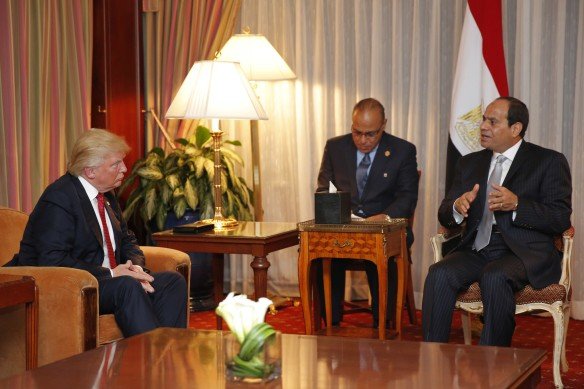
Donald Trump meets with President Sisi at the Plaza Hotel during the UN General Assembly session in New York, September 19, 2016. Photo by Dominick Reuter/AFP
As I say, there was nothing exceptional in my experience, except that I walked away. Thousands around the world face the machinery of security every day, the manifold terrors of counter-terror, and I have nothing to offer but one small piece of advice. Remember: The police are stupid. In the end, that’s the main hope for our own iron age. The cops are studded with guns and sealed in Kevlar, but they have no minds.
The he-men in the airport office knew barely more about language, technology, life in its intricacy than a dog knows about a train. And their stupidity is only a distilled version of the larger stupidity of the state. (A victim entrapped over the Web whom I interviewed in 2003 told me: “All of them—the judges, the lawyers, even the niyaba [prosecutor] — knew nothing about the Internet. The deputy prosecutor even said, ‘I know nothing about the Internet and I don’t have time to learn about it. What is it? What do you do on it? Do people just talk around with men?’ They knew nothing about how the things I was charged with actually worked.”) The state is an empty skull. The parasites in it spy and pry, but they cannot turn mere facts into knowledge. Their stupidity intimidates and oppresses, but it is also our strength. I learned a joke 25 years ago in Romania, and I still tell it, because it gives me comfort:
Q: Mickey Mouse, Donald Duck, the intelligent policeman, and the stupid policeman are eating Chinese food together. Who eats the most?
A: The stupid policeman eats it all. The other three are imaginary.

Cartoon by Andeel, Mada Masr: Get in / إركب
If you like this blog, we’d be grateful if you’d pitch in:

Trump
“Weeping,” a South African anti-apartheid song, sung by Vusi Mahlasela
Donald Trump was was not elected despite universal disbelief that it was possible. He was elected because of universal disbelief that it was possible. The most crucial factor in his resistible rise was the profound faith that it couldn’t happen here. I shared this; I was as punch-drunk as anybody by midnight Tuesday. But the blitheness had been almost everywhere; and what kind of unreal vision of the United States, and of our strange moment in history, did it show?
There are thousands of examples but I’ll restrict myself to the field of punditry. Back in February, Jonathan Chait — who now, accurately, says “Collaborating With Donald Trump Is Doomed to Fail” — wrote that liberals should “earnestly and patriotically support a Trump Republican nomination”
The first [reason], of course, is that he would almost certainly lose. Trump’s ability to stay atop the polls for months, even as critics predicted his demise, has given him an aura of voodoo magic that frightens some Democrats. But whatever wizardry Trump has used to defy the laws of political gravity has worked only within his party. Among the electorate as a whole, he is massively — indeed, historically — unpopular …
At that point, Trump was running 3.4 points behind Clinton in the Real Clear Politics polling average, not a number suggesting the ironclad historical inevitability of defeat. Come May, George Packer in the New Yorker wrote that “Democrats probably won’t need the votes of the white working class to win this year. Demographic trends favor the party, as does the bloated and hateful persona of the Republican choice.” When that appeared, Trump was 3.1 points behind, and gaining. And the day before the election, the New York Times devoted a long, detectably gleeful article to describing “Trump’s Last Stand,” painting the desperate “neediness and vulnerability of a once-boastful candidate now uncertain of victory.” Thirty-six hours later, the vulnerable loser was President-elect of the United States.
Through a Looking Glass Darkly” by Mr. Fish, 2013. (Please see comment below for some more information about the portrait’s source.)
Racism and rage are older than the Republic, and they’ve never been in hiding. They are only-sometimes-latent possibilities in American life, part of the permanent repertory of rhetorics that politicians and entertainers call upon, part of the cache of emotions for citizens to feel (and fear), constant forces waiting for circumstances to unleash them. The assumption that all this hatred shrank to inanition through some combination of Obama, Lena Dunham, and Will and Grace was self-defeating. Trump is not “unprecedented“; nor does he represent a past that, as Clinton kept saying, we “can’t go back” to. He’s part of us, then and now. In living memory, George Wallace struck nearly all the notes in the Trump octave, down to the strutting, preening, boorish machismo (his famous threat to give a recalcitrant judge “a barbed-wire enema” could have come out of Trump’s mouth). Wallace never made it near the Presidency. but he got 45 electoral votes. The man he helped make President, Richard Nixon, added to a subdued version of Wallace’s racism a deep paranoia, a passionate adoration of foreign dictators, and a profound reliance on the indigenous surveillance state. It’s hard to remember this now, but a lot of sensible Americans believed that the United States was careening toward fascist politics and authoritarian rule under the Divine Milhous in 1972 — and that only the Watergate scandal forestalled it. A good many on the Left have been comparing Trump to a “Third World dictator.” It’s an insult to a Third World that give rise to Thomas Sankara, to Nelson Mandela, to Salvador Allende, to Jawaharlal Nehru. (It also echoes Trump himself, who repeatedly said the United States was becoming a “Third World country.”) But it has a scrap of truth if you mean the kind of kleptomaniacal, deadly autocrats the democratic, idealistic US has inflicted on its hapless allies in the global South for decades. Trump’s corruption, his shadowy relations with an overweening foreign power, and his alliance with domestic security cadres like the FBI suggest a regime worthy of Cold-War Guatemala. And that’s not “un-American”; it’s of the Americas, of us. It’s our history, too.
I don’t underestimate Trump’s threat. Wallace was defeated by the limitations of his regional appeal, by a still-resilient Democratic Party, and by the need of a suburban bourgeoisie to take its racism in slightly more civil form. Nixon’s undoing was an opposition Congress. Trump faces none of these things. His lust for power is enormous. There’s very little to stop him — so much for those “American institutions.” The menace of fascist authoritarianism is very real. Trump is a perfect storm, where all the foulest impulses in the national life come together with no visible check or balance. There is a lot of talk now about the dangers of “normalizing” Trump, treating his Presidency as if it were business as usual. The real “normalization,” though, happened during the campaign: treating the daily life of the United States as though placidity, “conflict resolution,” and consensus were the way things always had been and should be. This is an insane thing to think about the country at any time, but particularly in a year when police violence was on full display, when Guantánamo was still a going concern, when just over the rainbow the state was killing people in Yemen, Syria, and Iraq. We only start to understand Trump when we see these horrors as the unwritten constitution of the “normal.”
The US left is now in crisis yet again, this time arguing whether Trump’s victory should be ascribed to racism tout simple or to rage at the impoverishment of the white working class. It’s an important argument so far as it informs the question What do we do next? But it’s useless when conducted on Facebook where everything turns into either-or. Racism is not an abstract entity separable from historical circumstances. It is extremely concrete; the pressure it exerts on individual bodies, individual lives, is drawn from specific and immediate conditions that rouse it, shape it, use it, and give it strength. There is a long history in the United States of politicians channeling economic powerlessness into racist fantasies of power; local caudillos such as Tom Watson, or Theodore Bilbo, or Frank Rizzo knew exactly how to work this in their neighborhoods, on their streets. It’s better, though not entirely exact, to think of racism through the metaphor of latency again: as a set of possibilities immanent in the United States, waiting for the particular junctures where they can become not just potential but actual, can feed on blood. These are possibilities immanent in people, also, in the repertory of dreams and delusions available to every white person (and probably to many people of color). If Donald Trump sets up his Muslim registry, I can indulge the fantasy of marching to City Hall and putting my name on it, preferably while flashbulbs explode like excited Valkyries. Or I can fantasize about informing on the undocumented Pakistani store clerk who shortchanged me. Both fantasies are dangerous, in very different ways. Neither has much to do with reality — Trump’s registry is likely to be a subtler thing, specific to immigrants in ways that will obviate white-savior illusions, and less reliant on pliant informers than on invisible electronic surveillance. My point is, though, that the reality of unrestrained state power in which more and more of us will live, will oblige us to examine ourselves unsparingly, with a cold eye toward our motives and our dreams. An inner moral rigor resists power even as it runs the risk of reproducing it; it is the only recourse when everything else calls out for compromise. Trumpism will work by universalizing mistrust. Part of the necessary response is to mistrust oneself.
“Go Back to Sleep, America, Nothing to See Here,” by Mr. Fish, 2016
But it’s not just personal. Economics counts, and a left that can’t address this isn’t a left. The financial crisis of 2007-2008 was probably the largest transfer of wealth from poor to rich in human history, a massive expropriation of the already-expropriated. We are still living with the consequences. (Despite all the pity accorded poor white people in the last week, the most acute suffering the collapse caused fell upon people of color. This doesn’t delegitimate the anger of the white working class, many of whose hopes and present realties were also destroyed. It does remind us again that racism divides capitalism’s victims not just from one another, but from reality.) What if, as Paul Rosenberg asks, Obama had taken even small steps toward tangible justice in his first year in office: prosecuting the culpable crooks in the financial industry, bailing out homeowners the way the Treasury did Wall Street, securing union rights instead of colluding in their destruction? Would the African-American as well as the white working class have felt a confidence that transcended the vicissitudes of identity politics, and turned out in sufficient numbers to defeat Trump? It’s not enough to say “We’ll never know.” People on the left know what is right. They shouldn’t allow the persistent sense that Obama is a decent man to derogate the certainty of what should have been done then, or to deflect from what has to happen now. Justice is not “normal” in the United States, but it needs to be.
“Dead End,” by Mr. Fish, 2016
We also need to scrap the palliative fiction that Trump’s populism, which turns economic fears into racist terror, is some sort of blow to neoliberalism or the “elites.” Divide and conquer is the classic strategy of capitalism in power, and that’s true whether the power rests with Ruhr industrialists or New York investment bankers. Trumpism is perfectly consistent with this. Fredric Jameson points out that “today, all politics is about real estate“:
Postmodern politics is essentially a matter of land grabs, on a local as well as a global scale. Whether you think of the question of Palestine, the settlements and the camps, or of the politics of raw materials and extraction; whether you think of ecology (and the rain forests) or the problems of federalism, citizenship, and immigration; or whether it is a question of gentrification in the great cities as well in the bidonvilles, the favelas and the townships and of course the movement of the landless — today everything is about land.
You can add Standing Rock, or Julius Malema; it’s absolutely true. The world is full. Capitalism has seized and commodified nearly all the land on earth, with the exception of Amazonia, some scattered areas of tribal or indigenous commons (now being stolen by police and the World Bank), and a few national parks. The space for expansion is gone; what’s left is to battle over what’s already branded, owned. No coincidence, then, that the most powerful engine of the world economy will now be ruled by a real-estate magnate, whose only skill is stamping his personal brand on things, a grotesque version of private property as pure performance. No one is better qualified than this idiot to wage capitalism’s war over control of space, to defend its hard-thieved acres and squirrelled-away square feet, to keep the rents too damn high.
Democracy in the United States was predicated, for its first two centuries or so, on land (once taken from its original users) being plentiful and cheap, and labor (at least in its free forms) scarce and expensive. These conditions slowly built a stable, somewhat contented working class who could bargain collectively, join the bourgeoisie, afford to own things. Since the 1960s, in the neoliberal ascendancy, there’s been an immense reversal. Land — or, more properly, space, whether farmland or a downtown loft — is in short supply and increasingly expensive. Meanwhile, there’s more than enough labor for the skewed new economy, and real wages have kept falling. This is how Trump made his indeterminate millions. It means an economy of massive inequality, misery, and hyperexploitation. It means the end of the apparent stability of the United States. The politics of such a lifeworld are inherently unstable. As Mike Davis has repeatedly shown, the burgeoning dispossessed will be a constant threat to the possessions of their dispossessors. The state will use more and more violence to protect the property of those who sustain it. Repression will become more and more continuous and constant; resistance will find fewer and fewer spaces to survive. Donald Trump is the ideal leader for this new world of walls and cowards. He is the ideal weapon.
We are in a violent new era, and we are not sure how to live. We will have to educate ourselves in many things we thought we knew. We will have to learn a different kind of speech: one that shocks but not mindlessly, one that has a purpose, one for those who are not our friends or our fellow believers. We will have to reach outside our arrogance and our need for comfort. We will have to relearn old lessons of patience, cunning, and endurance. We will have to humble ourselves before those who have fought this kind of fight before; suddenly, the lessons of Andijan or Mohamed Mahmoud Street may mean more to people in Seattle or Atlanta than they ever thought possible. For myself, I sit round thinking of Auden:
The stars are dead. The animals will not look.
We are left alone with our day, and the time is short, and
History to the defeated
May say Alas but cannot help nor pardon.
(“Spain,” 1937)
Or Brecht:
It takes a lot of things to change the world:
Anger and tenacity. Science and indignation,
The quick initiative, the long reflection,
The cold patience and the infinite perseverance,
The understanding of the particular case and the
understanding of the ensemble:
Only the lessons of reality can teach us to transform reality.
(“Einverständnis,” 1929)
Or:

If you like this blog, we’d be grateful if you’d pitch in:
Selling out: The gays
and governmentality
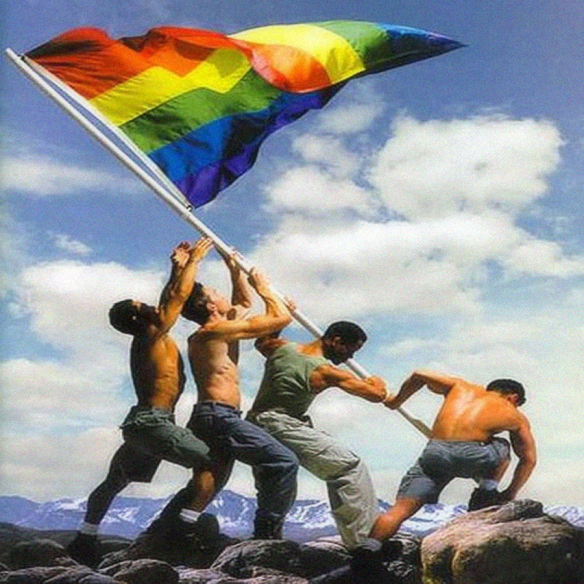
On October 13, Thailand’s King Bhumibol Adulyadej died. 88 years old and the longest-seated of the world’s shrinking stock of monarchs, he was almost uniformly revered by a grieving public. Certainly he embodied unity in a country riven by fractious politics and class struggle. It can’t have hurt his popularity, though, that Thai law punishes lèse-majesté with three to fifteen years in prison. Any criticism of the King, previous kings, the royal dynasty, members of the royal family, the monarchy in general, or the monarch’s fantastic wealth — he had more than US $30 billion in the bank — can land you in jail. Easy to get people to love you if the alternative’s a prison term.
Odd, then, when Outright International, the LGBT rights organization, whose Twitter feed is generally confined to issues of sexuality, suddenly retweeted a series of encomia to the late King. After all, no one’s threatening them with prison.
These tweets were spawned in UN missions, and the stultifying UN-speak shows; a tribute that lauds someone as “a strong supporter of multilateral systems in sustaining peace” was written by bureaucrats, or is covering up for something, or both.
Mainly, King Bhumibol was a strong supporter of military dictatorships. Back in 1957, he helped engineer his first coup, encouraging a friendly general to rebel against an army-led government that had tried to restrict royal prerogatives. More recently, he endorsed the 2006 putsch that deposed populist prime minster Thaksin Shinawatra; in 2014 he similarly oversaw the overthrow of a cabinet led by Thaksin’s sister, installing the most draconian and brutal military regime the country has seen in decades. (In 2014, the dictatorship cemented its control by arresting dissidents under the lèse-majesté law; in 2006 the army justified the coup by claiming that insults to the King were surging, and only soldiers could safeguard the royal reputation.) Even the King’s elected governments had his mandate to use a harsh hand: in 2003, Bhumibol supported Thaksin’s “war on drugs,” which smeared the country with the blood of almost 3000 extrajudicial killings. As the monarch’s American biographer wrote after his death, “King Bhumibol did not set out to build a representative democracy or promote the rule of law. For him, parliaments were impermanent, disposable … Democracy was never his goal for Thailand.”
prison.
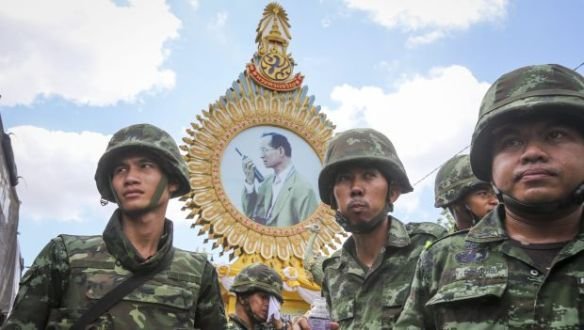
Thai soldiers gather under a portrait of the King following the 2014 coup: Photo: EPA/Diego Azubel
So it’s interesting for a human rights group not known for engaging with Thailand to go out of its way in the late King’s praise. By contrast, Human Rights Watch, longtime critic of Thai governments (and the lèse-majesté law), posted just one neutral sentence on its Thailand page.
And Amnesty International stayed decently silent. Two weeks before the King’s death, Thai police had shut down an Amnesty meeting in Bangkok, in order to ban the group’s report accusing the military junta of “a culture of torture.”
Those gratuitous retweets, though, had little to do with Thailand’s rights record — or “multilateral systems,” or “sustaining peace,” etcetera. They had to do with power: power at the UN. Outright International works extensively on LGBT rights at the United Nations (sometimes with good results, sometimes, in my view, not so much). For five years, Thailand has supported UN measures favoring LGBT rights. LGBT praise for a defunct and anti-democratic King is a low-cost way of lubricating that support. (Moreover, the Kingdom of Jordan’s UN mission, where one of the tweets bemoaning a fellow-monarch originated, has been making ambiguously positive noises about LGBT issues in official settings; they need encouragement. Retweeting them cozies up to two Kings at once.) An organization’s tweets don’t have much impact on the world. I fear, though, that parroting praise of the late King tends to set aside the language of human rights in favor of strategically satisfying a few diplomats. I worked for Outright for many years. I was its program director until 2002. There was no Twitter then. But if there had been, we wouldn’t have sent those tweets.
The tweets aren’t important, but the issue is. How do human rights relate to power? Surely the answer’s simple: Rights rely on governments’ power to realize and enforce them. Maybe the question is, instead: How do we, who defend human rights, relate to power? Are we inside it or outside it? What will we do to get power’s attention, sustain its regard, enjoy its favors? And what does that do to us?
Gay Power, I: Protester in New York City, 1967. Photo: New York Public Library
The questions are particularly acute for people defending LGBT rights. For a long time, in almost every country in the world, LGBT activists had no access to power at all. In the US, 20 years ago, we had trouble just getting a meeting with the State Department. When I lobbied the UN’s human rights meetings in Geneva back then, even diplomats from the most supportive states had to be persuaded that queers weren’t either a distraction or a joke. Now plenty of governments say they’re all in for LGBT rights. No doubt some are propelled by politicians’ sincere concern (if that’s not an oxymoron). Others want to appease voters back home; still others see a convenient way to pinkwash their national reputations. They approach
the subject, that is, with the usual confused and chiaroscuro motives states show. Their ministrations, though, give LGBT activists the unfamiliar sense of power, even if the reality is still remote. They’re listened to, suddenly; the elixir of authority is sitting on the table, with three icecubes and a swizzle stick, and even the smell intoxicates. How do they accommodate themselves to this new condition? Many queer groups lack any history of negotiating their relationships to power — the history that feminist movements, for example, have accumulated through decades of harsh experience. Moreover, they are less and less inclined to listen to those other movements, or learn from their stories. Wounded by hate and vitriol, LGBT activists’ egos are often desperate and valetudiniarian. Who can say how well we’ll withstand the swift explosion of self-regard that comes when ambassadors and presidents, principalities and powers, bestow on us the swerving lighthouse beam of their attention?
Not well, I think.
But this goes beyond LGBT movements; the question afflicts the whole of human rights activism. Human rights have long had two sides, two Janus faces. In their international iteration they originated as, quite literally, powerless, a corpus of principles devoid of virtually any enforcement. Human rights, even as late as the post-World-War-II Universal Declaration, were pure critique untrammeled by practical authority: a criticism of the actual terms of national legal systems, a semi-Utopian vantage from which to look down on the existing norms of positive law and judge them. They were a language more for activists than lawyers, more competent to imagine a living future than to mandate it. Over time, human rights grew into a system of positive law in their own — er — right. They were embodied not just in demands and needs but in codes and treaties; increasingly the lawyers took over; and as rights became norms, they acquired, and their exponents desired them to acquire, power. This is necessary and, mostly, good. It’s good that rights are codified, good that they have clout, very good that some governments take them seriously. But to work in human rights is still to be caught between these poles, between the idea that rights criticize power and the idea that they should possess it. Should we confront the bearers of state power as opponents, or as partners? Did the late king of Thailand deserve our analysis and anger, with a history of abuses to be considered and condemned? Or was he, along with the government that commemorates him, a potential ally in cooperative work, in making rights principles matter to a thoroughly compromised world? Should we tweet our own understanding of his record, or retweet the Thai Mission to the UN?
Those tweets were trivial, but there are more serious cases. The Thai Mission is one thing, but what if you’re dealing with the hugely powerful government of the United States? What’s the right relation to that hideous strength?
Gay Power, I: Protester in New York City, 1967. Photo: New York Public Library
Here’s a story. On October 26, Human Rights First and the Human Rights Campaign (HRC) — the latter, for any non-denizens of GayWorld, is the richest gay group in North America — hosted a speech by Susan Rice in Washington, DC, on “Global LGBTQ Rights.” Rice was Obama’s first ambassador to the UN, and now chairs the National Security Council. Introducing her, HRC’s head Chad Griffin said that “LGBTQ people around the world are looking to us” to be a “beacon of hope.”
And at a time when extremists are throwing gay men off buildings, when transgender women are being relentlessly attacked in Central America, when laws are being passed to silence and marginalize LGBTQ people, they need American leadership now more than ever before.
This is telling the US government what it wants to hear: America is moral, America is exceptional, and America leads everything (even Honduran travestis march in line). Chad Griffin really believes this. Otherwise, why would HRC tweet these words to the world, oblivious that activists elsewhere might resent the picture of them pining for a US cavalryman on a white horse?
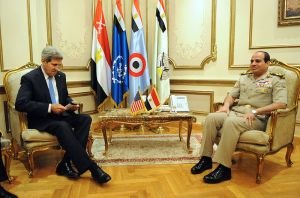
US Secretary of State Kerry meets with junta leader Sisi, Cairo, November 2013. Photo: US Department of State
Arrests of queers in Egypt aren’t a quaint facet of the previous decade’s history. They’re happening now. Egypt has probably sentenced more LGBT people to prison since 2013 than any other country in the world. Neither Rice nor anybody else in the US government will discuss these arrests, much less condemn them. There are more than 40,000 political prisoners in Egypt; torture and death squads are rampant. The US refuses to raise these
facts with its its Cairene client-tyrant in any consequential way — because “it would be too damaging to our relationship with Egypt.” For Rice to claim something’s changed because State Department staffers can now watch movies about handsome brown men being abused, and do so on government time — that is obscene. Screw the movie, Susan. Stop endorsing torture.
Yet the Human Rights Campaign condones torture; and so does the audience of professional gays who turn out to applaud Rice’s platitudes. Not that they’re bad people or malevolent organizations; far from it. They’d be horrified if they ever met a torture victim face to face. But they know the Obama administration is power, and they believe it’s on their side. They can’t contravene power. They see it has done good in places; so they can’t see or speak about places like Egypt where it’s done wrong. The convolutions of a state whose actions aren’t all categorizable under the same moral absolute are too much for them. And to raise their voices risks alienating that power. Then their own capacity for good, so invested in the authority of others, might slip away. So they let Rice drone on; they don’t confront her; they convince themselves that the government’s symbolic gestures — screening a film! making a donor an ambassador! – have a magical impact on the reality that rests in people’s lives. Nor does this blindness stop with Egypt. Chad unctuously imagines poor Honduran travestis long for US “leadership” to free them. They don’t. They long for an end to the violent waves of social-cleansing killings that the 2009 coup d’etat, enabling right-wing death squads, unleashed. And they know the US (and Secretary of State Clinton) propped up the bloody post-coup regime. Guns we send to Honduras murder travestis in the street. Not to see the complexity of these relations, not to understand how the people you flatter are implicated in the abuses you abhor, goes deeper than sycophancy. It’s complicity.
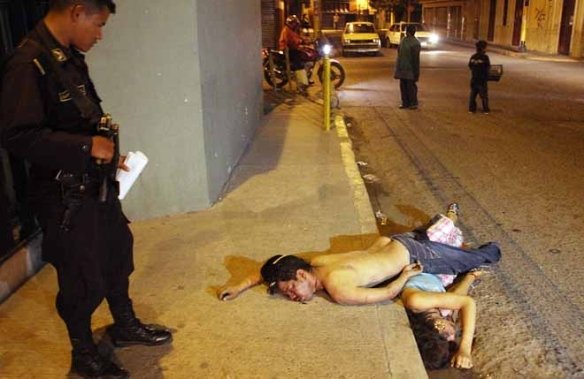
Corpses of an unknown man and a trans woman dumped on a street, Tegucigalpa, Honduras, January 2010. Photo: Tiempo, via Blabbeando.com
There’s a point where human rights, entangled with the hunt for power, stop being human. I will lay my opinions on the table, as someone who has worked within the force-field of human rights for 25 years. Human rights are not just a body of law, but a pattern of thought: a way of criticizing things that are and their existing arrangement. Either they retain some quantum of their dissenting energy, their capacity for radical critique, for questioning equally the premises and practices of friend and foe – or they cease to be of use. Rights exist in opposition. I do not believe human rights activists should readily celebrate governments, or fawn over their representatives, or adopt their language and agendas. I believe human rights activists who do that stop being human rights activists, and become something else. As a mode of thinking, human rights must negate in order to affirm; only through undermining the reified authority of what is can they clear a space for the liberating fortuity of difference, of what isn’t yet, of an alternative. Adorno wrote: “The uncompromisingly critical thinker, who neither superscribes his conscience nor permits himself to be terrorized into action, is in truth the one who does not give up. Thinking is not the spiritual reproduction of that which exists. As long as thinking is not interrupted, it has a firm grasp upon possibility. Its insatiable quality, the resistance against petty satiety, rejects the foolish wisdom of resignation.” Only by abandoning the false positivities that power always posits, and pursuing the relentlessly negative logic of that thought, can the discourse of rights change anything that needs to be changed about the world.
I called this essay “selling out.” Sometimes we activists indeed can sell out friends, allies, even those we call our own kind — sometimes without seeing it; queer Egyptians, say, sold by the US to sustain the deadly dictatorship. There’s another meaning, though. Sometimes we sell our very outness to the holders of power. To keep proximity and access, we hand them our presence and our visibility to exploit. We’re here, we’re queer. We’re useful.
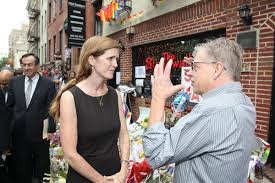
Gay Power II: UN Ambassador Samantha Power discusses LGBT rights with a man and his demonically possessed left arm outside the Stonewall Inn, New York, 2016. Photo: US Department of State
Think (on the first point) of the arguments this year among LGBT movements about creating a new special mechanism at the UN, to research and respond to violations. These discussions were divisive. Many wanted a mechanism to deal broadly with diverse issues of sexual rights: for instance, connecting “sodomy laws” to other laws that control sexual freedoms. Others, including leaders of many LGBT organizations, wanted their own mechanism, in effect — one focused on a particular identity. I was in
Geneva while the UN debated the mechanism; I was struck by how advocates of the narrower mandate reacted when I asked why the rights of sex workers were excluded from it. The general response was: sex workers had nothing to do with LGBT communities. They weren’t relevant, useful allies; and sex workers within queer populations seemed no longer to exist, like Neanderthals or moderate Republicans. I heard this even from people who I know perfectly well have paid for sex with queer sex workers, apparently in episodes of absent-mindedness. The end result? The narrow mandate won. Laws targeting sex work – laws that imprison thousands of LGBT people — were excised from the public ambit of LGBT concern. Invisible sex workers were sold out; visible and respectable LGBT activists acquired a UN post. So it goes.
And think how the World Bank loudly declared, in 2013, that it was going to adopt LGBT rights as a priority – pretty much its first-ever human rights priority; a project it launched by invoking Uganda’s anti-LGBT legislation to cancel a loan targeting maternal mortality. Health and reproductive rights in East Africa are easy to sell out; they lack a DC lobby. American NGOs, the Obama administration, and Democrats in Congress could see Ugandan LGBT people, but not Ugandan women. (The two, again, don’t overlap.) But there was another aspect to the bargain; the Bank’s pronouncements on LGBT rights had the effect – perhaps not planned at first, but obvious afterward – of enlisting vocal, visible queer activists in powerful countries to support the institution and its leaders. (Jim Yong Kim, the Bank’s embattled president, even dropped in on BuzzFeed’s offices while pushing for a second term, to remind its gay readership how gay-friendly the Bank is: not the sort of campaign stop previously common on the commanding heights of the world economy. Imagine Alan Greenspan advertising the Federal Reserve by parading in Pride.) Even LGBT activists in powerless countries — the countries the Bank lends to, and often destroys — have their usefulness. Although no policy changes and no new programs have come out of the Bank’s well-publicized concern, it does annually fly LGBT campaigners from the global South to its Washington HQ to sit round a table, be consulted, and be photographed. You can see the Bank’s calculus; these are economists, after all. Surely every activist tempted with the fleshpots of DC means one less activist who’ll join a rally against structural adjustment or debt or the Washington Consensus. Why protest outside when you can sit inside with a per diem? With enough time, LGBT politics around the globe will don the values of Davos and shuck off those of Porto Alegre. That may or may not happen: the Bank has never figured out how activists really tick. But In a decade when many LGBT movements actually do have increasing influence in their domestic politics — and are increasingly resourced by the US government, which runs the Bank — it’s a reasonable bet to make, if not a sure one.
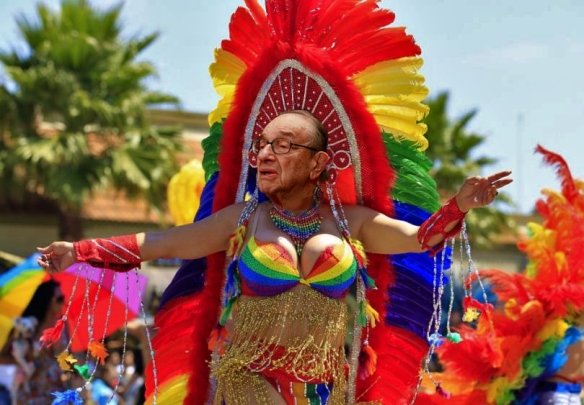
Imagine
Michel Foucault employed the idea of “governmentality” to describe the multiple means, from the sweeping to the microscopic, by which institutions create, mold, control, and discipline subject populations. Foucault also showed that to participate in governmentality, to share in the play of power, is equally to be shaped, to be controlled, to be disciplined. Power is exercised not only through, but within, the powerful. The conscious agent is also the inadvertent victim.
The more LGBT movements appropriate their portion of power, they more they risk becoming its subjects and servants. The more HRC stakes its claim to participate in US foreign policy, for instance, the more it constricts its vision. The seductive project of building an “LGBT foreign policy” disciplines LGBT Americans — and HRC itself — not to think of foreign policy in a critical or complex or comprehensive way.
Governmentality is an academic concept, of course, arcanely argued over by scholars. In fact, I can describe that entanglement and complicity simply: in a monosyllable, even. Sometimes giving a thing its proper name is analysis enough. But I’ll repeat it a few times; in speaking of power and the powerful, one should make the word sound polysyllabic, important.
Shame. Shame. Shame.
Liv Ullman and Max von Sydow in Ingmar Bergman’s Skammen, 1968
The UN, seen from Khayelitsha: Guest post
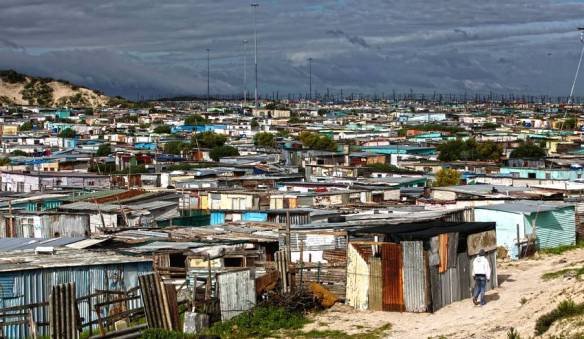
Khayelitsha, Western Cape, South Africa
On June 30, the United Nations Human Rights Council in Geneva passed a resolution establishing an independent expert (a special investigative mechanism, a slightly weaker title than the more usual “special rapporteur”) on sexual orientation and gender identity. Although you wouldn’t know it from most of the news reports, this move was controversial within LGBT movements. Some pressed for UN action against a wider range of abuses, for a recognition that issues of sexual and bodily autonomy are difficult to disentangle or to fit into convenient identity boxes. The final outcome occasioned celebration even as it raised questions. What are our movements’ relations to power? When are we agents, when are we patients, when are we acted upon and when are we actors in our right? What happens to us and our own autonomy when we derive our power from the agendas of “friendly” governments vastly and more malignly powerful than ourselves? How will the power we experience in the rarefied air of Geneva actually help those outside?
A post by Gabriel Hoosain Khan, a South African human rights activist and artist, dealt with some of these questions. I am publishing it here with his permission.
I am bewildered by the myth of Cape Town. As I drive on the N2 towards Khayelitsha – I know that the pretty green boulevards and the old Victorian houses will soon erode into an endless plain of informal settlements. I forgot that truth (again) during the previous night as I ate Bobotie and sipped wine in Observatory – the truth that Cape Town is not that pretty city on the southern tip. It is easy and gross privilege that allowed me to forget. Cape Town instead runs far up along a spine towards Somerset West, with dirty lungs on either side of the highway – letting the city inhale a poor black workforce every day, and roughly exhaling these workers every eve.
It is this binary which tints my perception of the recent vote at the UN on SOGI. This binary between the facades we sell about cities and processes and resolutions; and the realities of the communities on the ground that don’t taste the pleasures of the façade. In Cape Town, Camps Bay, Claremont and Seapoint are pretty and some of the safest areas in South Africa; while tens of kilometres away Gugulethu, Khayelitsha and Nyanga have limited access to sanitation and remain some of the most dangerous areas in South Africa (and the world). In Geneva it might be possible to celebrate a human rights gain – but that gain seems far removed from the room in Khayelitsha where I met three LGBTI youth groups last week. The beautiful paneled ceiling in Geneva (which I have seen in pictures) is unimaginable from the crèche where we meet – a zinc structure with no electricity, little furniture or flushing toilets.
Asiyi eKhayelitsha (We will not go to Khayelitsha), 1985 poster protesting forced removals by the apartheid regime. CAP Collection, UWC – Robben Island Museum Mayibuye Archives.
I might be a little cynical here – we have seen positive changes on the continent – but these have been slow. I guess I am keen to reflect on the political implications of human rights strategies which centre efforts in a language palatable to the global North. I muse on Fanon’s words — “Europe is literally the creation of the Third World” — as a guide: to the way human rights as employed reinforces the metaphorical normativity of “Europe” or “the west” or “the global North” as a white, liberal and civilized measure of humanity. I guess I am trying to examine SOGI/LGBTI/queer/trans strategies as practices (linguistic, interventionist and economic) which do not trouble the normativity of a human rights discourse that leaves colonialism, racism and global north exceptionalism largely unchallenged.
In using human rights without examining the racist/colonial/exceptional manner in which it is employed:
- we too divide our struggle through employing SOGI/LGBTI/queer/trans as a singular palatable thing – rather than a queer, feminist and anti-colonial resistance; and
- we continue to reinforce an expensive international system which does not help those who most need these mythological human rights.
In a way this myth of human rights has little to do with the messy colonial, racial, gendered, sexualized, classed realities of humans.
It says we deserve a piece of this myth whilst only affording this myth to a few bodies, and leaves largely unchallenged the global colonial/racist systems which perpetuate gross human rights violations (on and beyond LGBTI bodies). I wonder if we can challenge this normative trap of human rights . A normative trap which allows states like the US to talk loudly about human rights, whilst the indigenous peoples of that state and their leaders still do not have representation in that same UNHRC space? A trap which allows the Syrian government to have space and power at the UN whilst that same government has killed 12044 civilians in 2015? A trap which led me to think about SOGI/LGBTI/queer/trans issues in Khayelitsha as somehow separate from access to sanitation, electricity, quality education, public safety and street lights? I find this all very troubling.
Cape Youth Congress (CAYCO), June 16: Viva the Youth. 1986 (?) poster commemorating the anniversary of the Soweto uprising. CAP Collection, UWC – Robben Island Museum Mayibuye Archives.
I take a sip of my caffeine-filled cappuccino and feel a little guilty (I am meant to give up caffeine for Ramadan). Last week in Khayelitsha I met with youth groups using creative methods to empower LGBTIQ youth. One group used drama to document the history of local words and stories about LGBTI identities. Another, called Cape Inspirations, was a choir – they used song to build confidence in LGBTI youth and build community among vulnerable youth. Ikhewezi youth group used theatre – they performed a play inspired by the violence in Orlando; their play explored local experiences of homophobia and violence against women. In Mannenberg, I met two groups providing safe space for LGBTI people in a neighbourhood with high unemployment rates, plagued by gang-related violence. The Reach for Life Foundation provided much-needed shelter and psychosocial support to LGBTI youth; Behind the Red Door highlighted the prevalent and interconnected struggles of drug and alcohol abuse, HIV and homelessness among LGBTI youth. I visited both on the day the vote at the UN was being negotiated. Neither knew about the resolution, neither engaged the UN in any manner and neither had strong opinions about the vote. More importantly, neither were consulted by LGBTI organisations about what they wanted.
This highlights a limitation when it comes to our praxis as SOGI/LGBTI/queer/trans organisations. In attempting to engage with these international bodies – what do we lose? Lose in our purpose and mode as civil society actors; actors who unlike states should be giving voice, opportunity and space to those who are most vulnerable? If these positions do not represent the groups or ideas of those who are most vulnerable – or even engage those who are most vulnerable – whom do these positions represent? I wonder about this practice of negotiating at the top (for things we supposedly need or don’t need; for language we supposedly use or language with limitations) in a manner which does not engage the modes and ideas of those we still position at the “bottom”?
In South Africa – we too were easy to celebrate: our new constitution in 1996; which enshrined non-discrimination on the basis of sexual orientation, and the laws which followed (in quick succession) moving LGBTI from identities criminalized before the law – to legal equality. Even with these changes – I wonder who enjoys that freedom – the suburbs which have always been safe and affluent cupped in the bosom of Table Mountain – do enjoy some semblance of freedom that is coloured white and affluent and gay. But those in Khayelitsha and Mannenberg live a reality in many ways similar to before those laws passed. LGBTI people in Khayelitsha and Mannenberg complain of the same issues thet faced before the first SOGI resolution passed at the UNHRC in 2011. I am trying to make sense of this binary.
The Bagdad bombing — when over two hundred people died in a commercial district in Baghdad — marked a somber closing to the month of the 32nd UNHRC sitting, but also to the month of Ramadan; a month marked by violence, from the attack on the Pulse nightclub in Orlando, to the bombing of Istanbul’s Ataturk international airport. It is in this context of gross violence that I locate the actions of the latest UN Human Rights Council. It is in this context that I would locate the broader struggle for the rights of LGBTI people. It is here that I ponder about the resolution on SOGI.
for all the landmarks we celebrate
we are still niggers
and faggots
and minstrel references
for jokes created on the funny pages of a heterosexual worldthe horizons are changing
to keep pace with technology and policy alike
the LGBT manifesto has evolved into a corporate agenda
and outside that agenda
a woman is beaten every 12 seconds
every two minutes
a girl is raped somewhere in Americaand while we stand here well-dressed and rejoicing
in India
in China
in South America a small child cuts the cloth
to construct you a new shirt
a new shoe
an old lifestyle held upright
by the engineered hunger and misuse of impoverished lives
– Staceyann Chin
Medu Art Ensemble (designer: Judy Seidman), The People Shall Govern, Botswana/South Africa, 1982.
Cairo, and our comprador gay movements: A talk
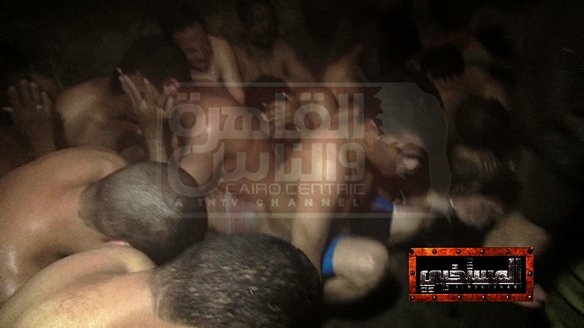
Photo taken and publicized by Egyptian journalist Mona Iraqi, showing arrested victims of the 2014 Cairo bathhouse raid over which she presided
On June 16, I gave a Human Rights Lecture as part of the program of Toronto Pride, on the 2014 bathhouse raid in Cairo and the ongoing crackdown on suspected trans and gay people in Egypt. Several people asked for the text, and I’m publishing it here. I owe much gratitude to Nayrouz Abu Hatoum, who introduced the lecture and placed it in a regional context. Many thanks are also due to Mathieu Chantelois of Pride Toronto; the hardworking staff of both Pride Toronto and The 519; and Brenda Cossman, Director of the Bonham Centre for Sexual Diversity Studies at the University of Toronto, who together sponsored and organized the talk. I am also very much indebted to John Greyson and Stephen Andrews, artists and activists, who helped make the whole thing possible.
For any who perversely want not to read but to watch me dissect this sort of thing, here’s a talk — on similar but not identical themes — I gave at Princeton University this spring:
And here is the Toronto lecture:
I feel overwhelmed.
I am overwhelmed to see so many of you here. But I am also overwhelmed as so many of us feel overwhelmed right now: there is too much to talk about, and too little one can actually say.
I was asked here to describe the campaign against LGBT people, especially trans women and gay men, ongoing for three years in Egypt: particularly the now-infamous police raid on a bathhouse in Cairo in December 2014. I was asked partly in the context of the 35th anniversary of the bathhouse raids in Toronto in 1981 — “Operation Soap.”
The question was: how much consistency across time and space shapes the persecution and oppression that queer people face?
And here we are, in this moment, on this day, in this juncture: and I know that everyone in this room is thinking about Orlando.
In the US, now, you can witness a political contest over what that event means – over what frame we’re going to use to understand it. This battle is also over whether it’s a local event or a global one, how much it crosses those boundaries of time and space:
- the right wing – and Donald Trump – insisting this is “about” terrorism, about porous borders, about alien violence invading our spaces;
- the left insisting this is about our, American, indigenous violence, our own fundamentalism, our guns, our propensity to see difference as a question of firepower.
These either-ors imply that Orlando was easily understandable, and can be not just comprehended but owned. Yet this kind of debate also indicates how deeply an instability of space — this troubled relationship between here and there, the local and the remote — has become integral to our thinking, and to our selves, in this increasingly elastic world.
It’s a world in which images circulate rapidly and globally; in which certain events become global, resonate far beyond their origins, are part of how people understand themselves , so that in South Africa or the Philippines, Orlando morphs into a reference point. It’s right that it be a reference point. The enormity and the suddenness of the violence mean it instantly touches innumerable queer people’s deepest fears. Yet some other events don’t circulate at all.
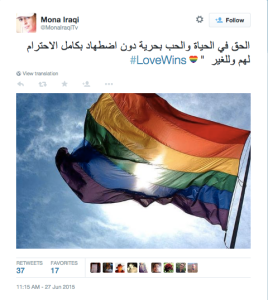
Mona Iraqi, Egyptian informer journalist extraordinaire, celebrate’s love’s victory in the Obergefell case, summer 2015
I’ll cite a friend of mine, a feminist in Egypt, writing about Orlando. She also speaks of how images spread globally – in this case, the celebratory images of gay triumphs. The killing, my friend writes, is “an ugly reality check to the fakeness of celebrating love wins” — by which she means that ubiquitous social media jubilation after same-sex marriage was legalized in a single, powerful country, the US.
When love wins happened, the Egyptian authorities were having raids arresting gay men and trans here. We couldn’t unsee the relation between the escalation of risk for being queer here and the media discourse which was commenting on love wins and which was [making Egyptians] realize that there are people who are actually homosexuals.
And she adds: “I am afraid that contrast can escalate badly. Anywhere.”
So: connections, and contrast. I’ll start with a short video. It shows someone who was swept up in the crackdown that’s going on in Egypt: a trans woman, a leader in her community, named Malouka. Police arrested her in December 2014. The press vilified her as “the most dangerous homosexual in Egypt.” (Egyptian media recognize no meaningful distinction between sexual orientation and gender identity as comprehended in the West, just a collective and only vaguely differentiated category of “perversion”.) The video was obviously filmed in a police station. A website based in the UAE, one with close ties with Egyptian police, published it. It’s disturbing; I wouldn’t show it except that I want to disturb you. It shows Malouka traumatized, probably beaten, though it’s not clear what they have done to her. She keeps repeating, over and over: “My father never loved me.”
Ordinarily, I wouldn’t replay such images without permission of the person they show. Malouka, though, simply disappeared into the vast Egyptian gulag. A court sentenced her to six years. With her blood family rejecting her – legally recognized relations are almost the only people with even intermittent access to prisoners in Egypt – only the barest information emerged about what happened to her. A rumor six months ago said she had committed suicide in detention. I believe it was untrue; but we were not even able to confirm that.
Let me describe what has been happening in Egypt for the last five years.
In 2011 — you know this — there was a revolution and Mubarak was overthrown. The military took power, in the form of the Supreme Council of the Armed Forces. In 2011-2012, it held first parliamentary and then presidential elections, which were multiparty, competitive, and generally free. And both were won by the Muslim Brotherhood.
For a year, then, from mid-2012 till July 2013, Egypt had a conservative government, but a democratically elected one: the only democratically elected government in Egypt’s history. In fact, the one year of Mohammed Morsi’s presidency was probably, in certain senses, the freest in Egypt’s modern history. The relative freedoms to speak, to criticize, to demonstrate and to agitate came not because the government was liberal – it wasn’t – but because it was weak. Still, those freedoms were tangible.
Egyptian queers were also enjoying a degree of freedom, an ability to occupy social spaces from which they were previously debarred. Back in the three years from 2001 to 2004, there had been a massive crackdown on men having sex with men, by the Mubarak government. Probably thousands were arrested and given sentences of up to 5 years. The circus of raids and show trials served up a convenient distraction from political and economic problems. But in 2004 it stopped, and for the next nine years there were very few arrests under Egypt’s laws against homosexual conduct. Indeed, from 2008, police in Egypt focused more on repressing political dissent in the increasingly volatile public sphere, and less on day-to-day policing, including patrolling the frontiers of acceptable morality. And after the revolution, the police virtually disappeared from urban streets. They had been the most hated symbol of the old regime, and in the new conditions they were virtually were afraid to show their faces.
With their retreat, LGBT people became increasingly visible in the downtown scene in Cairo. They occupied the decrepit city center’s cheap cafes and bars; they used the Internet to make new kinds of virtual community.
In July 2013, a carefully plotted military coup overthrew the Muslim Brotherhood government. The new junta, under General Abdel Fattah el-Sisi, quickly showed itself repressive in an unprecedented degree. The military’s ruling principle was that the old Mubarak regime had failed, was overthrown, because it was too weak. It had allowed bloggers, journalists, human rights activists, and other perverts too long a leash. The new state wasn’t going to make that mistake again.
In August 2013, Sisi massacred over a thousand demonstrators supporting the ousted Muslim Brotherhood. It was a message written in blood that the old rules didn’t apply, that the leash was now a chokehold. The military took over all the interstices of daily life: the country was kept under rigid curfew for months. And the police returned. Egypt saw a concerted attempt to resuscitate intensive social control.
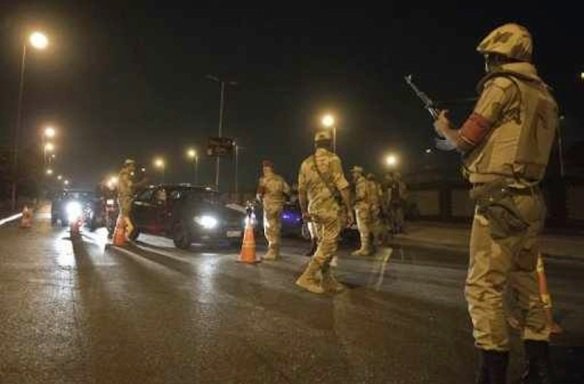
Military checkpoint in Cairo during the 2013 post-coup curfew
In October 2013, a few months after the military coup, came the first arrests of LGBT people. First police in a very working-class district of eastern Cairo shut down a local gym allegedly patronized by men seeking sex with other men. They arrested and tortured 14 people. Next came a raid on a private party in a Cairo suburb. Police loaded ten victims into their wagons. The cops leaked both these cases to the press; favorable headlines acclaimed the constabulary for cleansing the capital of its immoral unwanted. Someone in the Ministry of Interior decided that arresting “perverts” made good publicity for the police.
The arrests continued, applauded by an increasingly docile media. There were raids on homes, on private parties; people who looked differently or dressed differently could be seized on the street. Hundreds were arrested. Two incidents were particularly central in the storm of publicity.
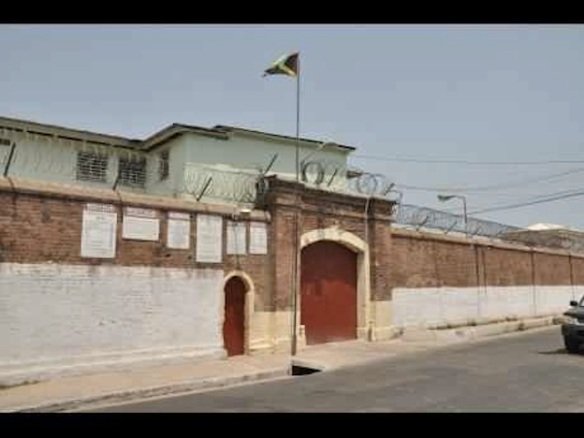
St. Catherine Adult Correctional Facility, in Spanish Town, Jamaica. Photo by Jermaine Barnaby for the Gleaner
This is a story about commodities. It’s a very contemporary one. When people lose their freedom and their rights, they become objects; but under triumphant capitalism, an object can only be a commodity, must bear a price. These days, the unfree are destined to be bought and sold.
The UK is building a market in prisoners; it exports the problem of prison to other states, and pays them to take it. The idea of the price of individual prisoners permeates the discourse. “The average annual cost of a prison place in the UK is £25,900,” Downing Street declares. The Daily Mail envisions a more upscale product, like free-range chickens, and pegs them at “around £40,000 a year.” The aggregate numbers are what counts in interstate relations — the “£25 million a year to keep 850 foreign prisoners behind bars,” the “£35 million every year” spent “locking up Poles” who strayed our way — but the single prisoner remains the nominal unit of exchange, like the lone dollar or pound whose abstract value in its minute oscillations can set unimaginably vast capital flows in motion.
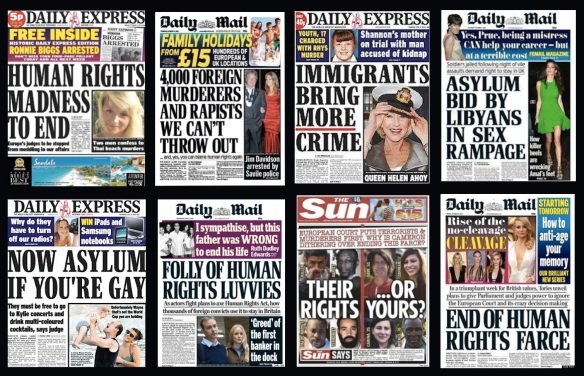
Fear of an actual planet
Yet this is the nativist language of an economy in recession. The UK’s reasoning is clear: if we have to spend that much on prisoners, which we don’t want to, let’s spend it on our own, not foreigners. “Deporting foreign criminals would free up prison places,” says a UKIP politician, letting us abuse and humiliate more of our own kind. There’s no reason the logic should stop there, though. Already the UK is figuring out ways to scrap the formality of a trial; Cameron’s government has come up with “Operation Nexus,” to simplify deporting foreigners charged with crimes but not convicted. And isn’t there a deeply buried message: Look. We would deport our own citizens if we could. Can a mere ID deter ostracism and eviction? With a West desperate to export crime and get rid of immigrants, why is birthright belonging more than a friable, disposable defense? Donald Trump already wants to scrap it. If the UK could find a penal colony, a Botany Bay, to take its suspect and unwanted nationals, how long would it cling to them over legal sentimentalities? As non-citizens become criminals, an insidious mirroring begins; the possibility — the fissure — of turning criminals into non-citizens opened, after September 11. The United States now can kill its own nationals without trial. It can pry in their doings as if they all were foreign spies. Correspondingly, zones of statelessness are starting to spring up, like weeds in the cracks of a formerly seamless planet. Guantanamo was the first, but not the last. Somaliland “enjoys relative peace and stability,” writes Reuters, parroting its Cameronland informants, “and analysts hope it might be a good site for more incarcerations in the future.” There you go — “peace and stability” now simply mark out promising lands for prisons, the way a geologist looks at a glittering slope of schist and sees oil. But the analysts don’t come to Somaliland for the quiet. Its draw is that it’s not a state; human rights treaties and duties don’t apply. Because such places are, in a global sense, lawless, states can set up laboratories there to make their own law. It’s not so much the fact that such small, silent interstices are appearing, in a world that used to talk of legality and freedom. It’s the fear that in those interspersed crevices and ruptures, our terrifying future is being born.
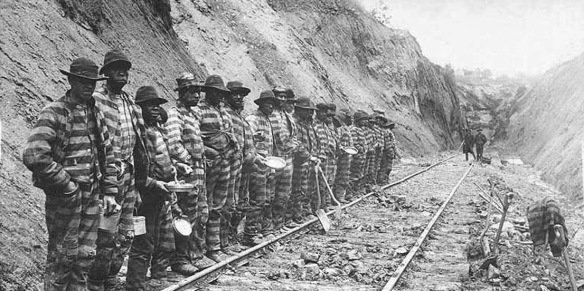
Chain-gang prisoners working on a railroad, Asheville, NC, undated photo (late 19th or early 20th century)
What we’re seeing now is twofold. Imprisonment is no longer a reserve away from the economy where the unproductive can be shunted; it’s completely economized. And the prison economy is going international. This traffic in chained bodies is growing. It resuscitates the authority structures of colonial slavery with new legal forms, purposes, and names. It’s frightening to see even a few of the old slave-trade routes revived like grass-grown oxen tracks, running from Britain to Jamaica or the Bight of Benin, from the Indian Ocean islands to the East African coast — though sometimes the shackled people are borne in directions opposite to the map’s faded arrows.
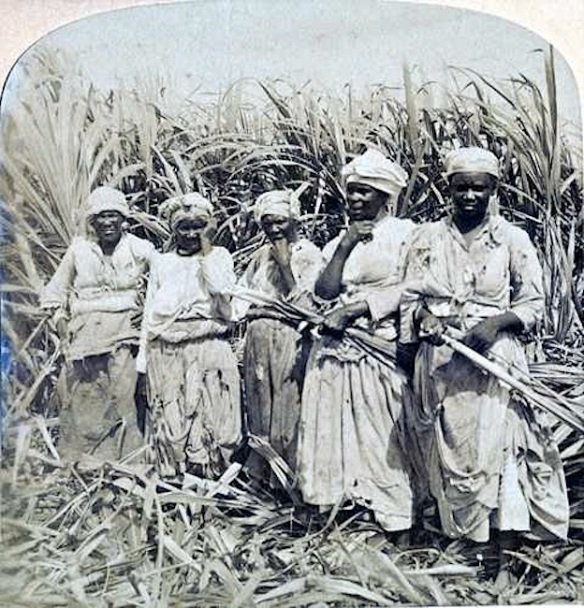
Stereoscope slide marked “Sugar Cane field hands, Montego bay, Jamaica, 1900,” from http://www.abdn.ac.uk/slavery/resource12c.htm. Although Jamaican slavery was abolished almost seven decades earlier, the conditions of plantation work were largely unchanged.
IF YOU LIKE THIS BLOG, WE’D BE GRATEFUL IF YOU PITCH IN
Email Subscription
Enter your email address to subscribe to this blog and receive notifications of new posts by email.Join 5,076 other followers


