

How Many Words Are in a 5 Page Paper?
You’ll typically write between 1,250 and 1,500 words in a five-page paper, depending on your font size, spacing, and topic complexity. Using a standard 12-point Times New Roman font with double spacing, each page holds about 250 to 300 words.
If you adjust font size or margins, that number changes. Your subject and style also affect length. Keep these factors in mind to manage your writing effectively, and you’ll find helpful ways to hit your target word count.
Factors Influencing Word Count in a Five-Page Paper

Although the length of a five-page paper might seem fixed, several factors influence its actual word count. You’ll notice that the topic’s complexity affects how many words you need to explain your ideas fully.
The complexity of your topic directly impacts the word count needed to fully express your ideas.
If your subject requires detailed analysis, expect more words. Your writing style also plays a role; concise writing uses fewer words, while descriptive or elaborate prose increases the count.
Additionally, the inclusion of quotes or citations can change the total word count, especially if you integrate lengthy passages. Don’t forget the use of headings or bullet points—they might reduce word count by breaking up text.
Understanding these factors helps you better estimate how much content fits into five pages without relying solely on a fixed word number. It’s all about knowing what your paper really needs.
Estimating Word Count Based on Formatting Settings

You’ll notice that font size plays a big role in how many words fit on a page. Changing margins or line spacing can also shift your word count considerably.
Let’s explore how these formatting settings affect your five-page paper’s length. It’s pretty interesting to see the difference just a few adjustments can make.
Font Size Impact
How does font size affect the number of words you can fit on a five-page paper? Simply put, the larger your font, the fewer words you’ll fit on each page. This directly impacts your total word count.
When estimating, consider these points:
- A 12-point font like Times New Roman is standard, fitting about 250-300 words per page.
- Increasing font size to 14-point reduces word capacity, possibly down to 200-220 words per page.
- Using a smaller font, like 10-point, allows more words—up to 350 per page—but might affect readability.
- Different fonts at the same size can vary slightly in word count due to design differences.
Adjusting font size thoughtfully helps you control your paper’s length without changing your content. It’s a simple way to manage how much you write without rewriting anything.
Margin and Spacing
Where do your margins and line spacing fit into the word count equation? They directly affect how much text fits on each page. Narrower margins allow more words per line, increasing your overall word count, while wider margins reduce space, cutting down the number of words per page.
Similarly, single spacing packs lines tightly, boosting word density, whereas double spacing spreads lines out, decreasing the total words you can fit. If you’re aiming for a five-page paper, standard settings typically use 1-inch margins and double spacing, resulting in about 250-300 words per page.
Adjusting these settings can shift your word count profoundly, so it’s vital to stick to your assignment’s formatting guidelines. Understanding margin and spacing effects helps you estimate how many words you need to meet your page goal.
Average Word Count for Different Academic Disciplines
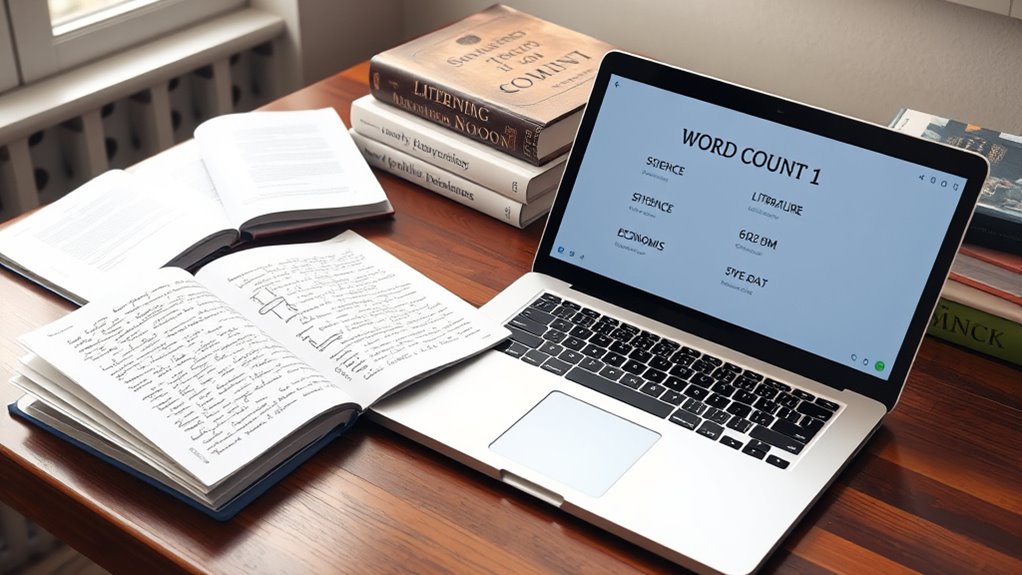
Different academic disciplines often require varying word counts for a 5-page paper, reflecting their unique writing styles and content demands. When you write for different fields, you’ll notice these differences:
- Humanities: Expect around 1,250 to 1,500 words, as these papers focus on detailed analysis and argumentation.
- Social Sciences: Typically, 1,300 to 1,600 words, balancing data interpretation with explanatory text.
- Natural Sciences: Usually fewer words, about 1,000 to 1,300, emphasizing concise reporting of experiments and results.
- Business and Economics: Often 1,200 to 1,500 words, integrating case studies and practical applications.
Knowing these averages helps you tailor your writing to meet expectations and avoid unnecessary padding or cutting. Always check your specific assignment guidelines, as requirements can vary even within disciplines.
How Font Type and Size Affect Your Page Length
Because font type and size directly influence the amount of text that fits on a page, they play a crucial role in determining your paper’s length. Choosing a larger font size means fewer words fit on each page, so your five-page paper will contain fewer total words.
Conversely, smaller fonts pack more words per page, increasing your word count without adding pages. Serif fonts like Times New Roman typically take up less space compared to some sans-serif fonts, subtly affecting your overall length.
When you’re assigned a specific page count, stick to the required font style and size—usually 12-point Times New Roman—to ensure your paper meets expectations. Adjusting fonts can alter page length, but it’s not a substitute for content quality or meeting assignment guidelines.
Tips for Managing Your Word Count Efficiently
How can you make sure your writing stays within the required word count without sacrificing quality? Start by planning your paper’s structure carefully. Outline your main points and allocate word limits to each section.
Plan your paper’s structure and assign word limits to each section for focused, balanced writing.
This approach helps maintain focus and balance. Also, review your draft critically to eliminate unnecessary words or repetitive ideas.
Here are some practical tips to manage your word count efficiently:
- Prioritize key arguments and support them concisely.
- Use clear, direct language instead of lengthy explanations.
- Break complex ideas into shorter sentences to stay concise.
- Regularly check your progress against the target word count.
Tools and Techniques to Track Your Writing Progress
You can keep your writing on track by using word count trackers and writing progress apps. These tools help you monitor your daily goals and overall progress without much effort.
Word Count Trackers
Wondering how to keep your writing on track? Word count trackers can help you stay focused and meet your goals efficiently. These tools provide real-time updates on your progress, so you know exactly how far you’ve come and how much is left.
You can use built-in word counters in word processors like Microsoft Word or Google Docs. Or, try online word counting websites for quick checks.
If you prefer, manual tracking with simple spreadsheets or journals works great too. Plus, there are browser extensions that display word counts as you type—pretty handy, right?
Writing Progress Apps
When tracking your writing progress, which apps fit your workflow best? You’ll want tools that offer real-time word counts, goal setting, and progress visualization.
Apps like Scrivener and Ulysses provide structured environments where you can track daily word targets and deadlines. If you prefer simplicity, tools like Google Docs or Microsoft Word show word counts instantly and let you monitor changes over time.
For motivation, platforms such as WriteTrack or Pacemaker let you set milestones and alert you when you’re ahead or behind schedule. Choose an app that integrates smoothly with your writing habits, whether you work offline or collaborate online.
Conclusion
Think of writing a five-page paper like filling a jar with marbles—each word adds up to reach your goal. Just as one marble might seem small, by the time you hit around 1,250 to 1,500 words, you’ve filled the jar perfectly.
Keep an eye on your font size and spacing, and use tools to track your progress. With these strategies, you’ll hit your word count without stress, making your paper both clear and complete.
So, how many words are in a 5 page paper? Typically, aiming for about 1,250 to 1,500 words will do the trick, depending on formatting like double spacing and font style. Remember, keeping track of word count throughout the writing process helps you stay on target and ensures your paper meets the required length effortlessly. This way, your 5 page paper won’t just meet the word count but also maintain clarity and flow.